Wall Street Rallies on AI Chip Deal as Indian Stocks Slide on IT Weakness
U.S. technology stocks advanced as renewed enthusiasm for artificial intelligence lifted semiconductor shares, while Indian equities came under pressure from selling in information technology stocks and concerns over elevated crude oil prices. The contrasting market movements highlighted a growing divergence between optimism surrounding US chipmakers and uncertainty over the outlook for India's IT services industry.
On Tuesday, October 27, the Nasdaq Composite climbed 1.2% to close at 26,477.81, while the S&P 500 gained 0.6% to 7,722.60. The Dow Jones Industrial Average edged up 0.03% to 52,377. The rally was led by AI-related stocks, with Broadcom emerging as a major beneficiary of a landmark financing arrangement involving Anthropic.
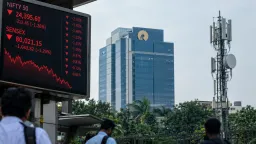
Meanwhile, Indian markets opened sharply lower on Wednesday, October 28. The Sensex fell more than 700 points at its intraday low, while the Nifty 50 slipped below 22,600 as selling pressure spread across heavyweight stocks, including Infosys and HCL Technologies.
Broadcom's $63 Billion AI Financing Deal Lifts Chip Stocks
Broadcom shares rose approximately 4% after the company announced a $63 billion financing arrangement to support the deployment of AI computing capacity for Anthropic, the developer of the Claude AI assistant.
The arrangement brings together Bank of America, Blackstone, Citi and Morgan Stanley to finance the purchase of Broadcom's AI accelerators and networking equipment, which will subsequently be leased to Anthropic. Deliveries are expected to begin in 2027.
The announcement reinforced investor interest in companies supplying the infrastructure required for AI development. Nvidia also advanced, gaining around 0.9%, while other semiconductor and AI infrastructure stocks participated in the broader rally.
The deal highlights the scale of capital flowing into AI infrastructure. However, investors remain focused on whether the industry's substantial spending will translate into sustainable revenue growth and profitability.
Indian IT Stocks Face a Different Outlook
Indian technology stocks faced selling pressure as investors assessed the outlook for IT services demand. Infosys recently lowered its revenue growth forecast for fiscal year 2027, citing weakness in its North American market.
The revised outlook raised concerns about client spending and the near-term growth prospects of India's technology services companies. Unlike semiconductor manufacturers benefiting directly from demand for AI computing infrastructure, IT services firms must also navigate changing client budgets, pricing pressures and the impact of AI-driven productivity improvements.
Elevated crude oil prices added to broader market concerns. Higher energy costs can increase India's import bill, contribute to inflationary pressures and weigh on investor sentiment toward emerging-market assets.
What the Divergence Means for Traders
The contrasting performance of US technology stocks and Indian IT shares illustrates why movements across global markets do not always translate into uniform gains.
US semiconductor companies are benefiting from demand for AI chips and computing infrastructure, while Indian IT services firms remain sensitive to corporate technology budgets and demand for outsourced services.
For traders, this divergence can create different opportunities and risks across indices. Nasdaq-linked instruments may respond positively to semiconductor momentum, while India's Nifty IT index may remain sensitive to company guidance and client spending expectations.
However, a single session's rally does not establish a sustained trend. Price movements can reverse quickly as earnings announcements, interest-rate expectations and geopolitical developments change market sentiment.
Markets Await Further Signals
Investors will continue monitoring major technology earnings, AI infrastructure spending, crude oil prices and the US Federal Reserve's policy decision for clearer signals about market direction.
The key question is whether strong demand for AI infrastructure can sustain US technology valuations while India's IT services sector navigates slower client spending and evolving industry dynamics.
For now, the divergence underscores the importance of evaluating individual sectors and their underlying business drivers rather than assuming that strength in one technology market will automatically lift another.
This article is intended solely for educational and informational purposes and does not constitute investment, trading or financial advice. Market conditions can change rapidly. Leveraged financial products carry significant risk and may not be suitable or legally available to all investors. Indian residents should ensure that any foreign-exchange or derivatives activity complies with applicable RBI, FEMA and SEBI requirements.