X-Energy's $1 Billion IPO: Why the World Is Betting on Nuclear Power Again
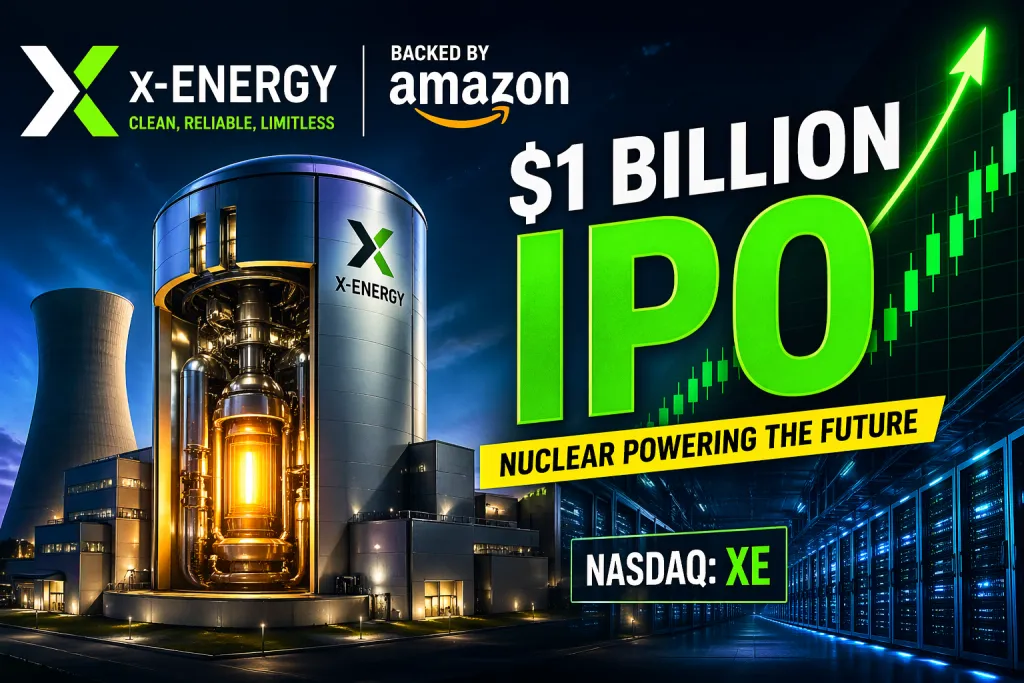
On the morning of April 24, 2026, a Maryland-based nuclear reactor startup began trading on the Nasdaq under the ticker symbol "XE." It had just raised over a billion dollars in its IPO. Its shares are priced above the market range. The offering was upsized. By every traditional metric, this was a roaring success.
But what makes X-Energy's debut genuinely significant is not the IPO mechanics — it is what the IPO represents: the clearest, most emphatic signal yet that nuclear power is no longer the energy industry's cautionary tale. It is the energy industry's next great bet.
The Numbers That Tell the Story
X-Energy, Inc. completed its initial public offering on April 23, 2026, raising approximately $1.02 billion in gross proceeds. The Maryland-based developer of small modular reactors priced its upsized offering of roughly 44.3 million Class A shares at $23 per share — well above the initial marketed range of $16 to $19.
That pricing gap is not a minor detail. When a company prices above its marketed range, it means institutional investors bid more aggressively than the underwriters initially anticipated. The demand was strong enough to push both the share count and the price higher than planned. In an IPO market still finding its footing after a brief slowdown in March — triggered by volatility linked to Middle East tensions and a broader technology sell-off — that kind of oversubscription signals genuine conviction, not just momentum chasing.
The IPO is a relief to X-Energy's investors, who have put about $1.8 billion into the company, according to PitchBook. This successful public debut follows more than $1.8 billion in prior private capital raised and positions the company to accelerate the commercialisation of its next-generation nuclear technology.
What X-Energy Actually Does — and Why It Matters
To understand why a nuclear startup is commanding this kind of investor enthusiasm, you need to understand what separates X-Energy from the nuclear industry of the past — and why that distinction matters enormously right now.
X-Energy is not building the nuclear power plants of the 1970s. It is not constructing the kind of massive, multi-billion-dollar, decade-long construction projects that became synonymous with cost overruns, regulatory delays, and public backlash. Those plants — large-scale, water-cooled, site-specific — are a different technology from an entirely different era.
X-Energy develops small modular reactor technology and manufactures fuel for advanced nuclear systems. Its flagship product, the Xe-100 reactor, uses helium as a coolant instead of water. That distinction is technically critical and commercially transformative.
Traditional nuclear reactors use water as a coolant, which means they require proximity to large water sources, complex pressurised systems, and expensive containment structures to manage the risk of water turning to steam under high-pressure failure conditions. The Xe-100 uses helium instead. Helium does not become radioactive when exposed to neutrons. It cannot explode. It cannot turn into steam. The entire failure-mode calculus changes.
X-Energy's reactors use TRISO particle fuel — a technology developed and improved over 60 years. The U.S. Department of Energy describes TRISO particles as the most robust nuclear fuel on the planet. Each TRISO particle is essentially a microscopic nuclear fuel kernel wrapped in multiple protective ceramic and carbon layers. The design is such that even in worst-case accident scenarios, the fuel retains its integrity and contains its own fission products. The reactor, as X-Energy puts it, is designed to be intrinsically safe — not because of external safety systems, but because of the physics of the design itself.
X-Energy's vertically integrated model pairs reactor technology licensing and long-term services with in-house TRISO-X fuel fabrication — a significant strategic advantage in a world where fuel supply security is becoming as important as reactor design.
The Amazon Connection: When Big Tech Meets Nuclear
No story about X-Energy in 2026 is complete without discussing Amazon — because Amazon is not just a passive investor. It is a strategic partner whose own infrastructure needs are directly shaping X-Energy's commercial roadmap.
Amazon led a $500 million Series C-1 round in X-Energy and has pledged to buy as much as 5 gigawatts of nuclear power from the company by 2039. Amazon secured priority allocation of reactor manufacturing slots and favourable pricing through 2039, with its first major project being the Cascade Advanced Energy Facility in Washington state, developed in partnership with Energy Northwest.
Why is the world's largest cloud provider investing half a billion dollars in a nuclear reactor startup? The answer lies in one of the most significant infrastructure challenges of the AI era: power.
The International Energy Agency projects global data center electricity consumption could double by 2030, creating an addressable market measured in hundreds of billions of dollars annually. Every time a large language model processes a query, every time a cloud server renders a video, every time an AI training run runs for weeks on end — electricity is being consumed at scales that are straining power grids across the United States and Europe.
Amazon operates hundreds of data centers globally. Its AWS cloud division is the foundation upon which a significant portion of the modern internet runs. Its AI ambitions — including its deepening partnership with Anthropic — require not just compute capacity but the power to run that compute capacity 24 hours a day, 365 days a year. Solar panels don't run at night. Wind turbines don't run when the air is still. Nuclear power runs continuously, regardless of weather or time of day, producing zero carbon emissions in operation.
For a hyperscaler like Amazon, that combination — reliable, always-on, carbon-free — is not just attractive. It is strategically essential, given the regulatory and reputational pressure around data center carbon footprints.
The Technology Stack: From Fuel to Reactor to Grid
X-Energy's investment case rests on a vertically integrated technology stack that covers the entire nuclear value chain — from fuel fabrication to reactor design to long-term service contracts. That integration is unusual in the nuclear industry and represents a meaningful competitive moat.
On the fuel side, X-Energy's subsidiary TRISO-X is building the TX-1 fuel fabrication facility in Oak Ridge, Tennessee — the first facility in the United States dedicated exclusively to manufacturing fuel for advanced small modular reactors. The facility will produce around 700,000 TRISO fuel pebbles per year, enough fuel for 11 Xe-100 reactors, with operations projected to begin in 2026.
The Department of Energy has been central to X-Energy's development. In October 2020, the company was chosen by the DOE as a recipient of a matching grant under the Advanced Reactor Demonstration Program — one of only two companies selected nationally, alongside TerraPower. The DOE partnership provides a 50/50 cost share worth up to $1.2 billion in reimbursement to advance the design, licensing, and commercialisation of X-Energy's first plant and fuel facility. Effectively, the U.S. federal government is co-funding the commercialisation of this technology — a level of sovereign backing that dramatically de-risks the development timeline for public market investors.
On the reactor deployment side, X-Energy's first commercial project is a partnership with Dow Chemical at its Seadrift, Texas, facility. The project proposes to develop four 80-megawatt SMR units to supply Dow's Seadrift site with safe, reliable, carbon-free electricity and industrial steam, replacing aging energy and steam infrastructure. Dow — a massive industrial chemical producer with enormous energy demands — is exactly the kind of industrial anchor customer that validates X-Energy's pitch that SMRs are suitable for heavy industry, not just power generation.
The reactor technology itself draws on a lineage of global research. X-Energy's leadership includes the original pioneers of High-Temperature Gas-Cooled Reactor design, and the company has refined more than 50 years of global research and operational experience from HTGR pebble-bed design programs in Germany and South Africa, combined with veterans from U.S. Department of Energy national laboratories. This is not a startup built on theoretical physics — it is a company built by people who have spent careers in nuclear engineering.
The Bigger Picture: Nuclear's Second Coming
X-Energy's IPO does not exist in a vacuum. It is the most visible data point in a broader renaissance of nuclear energy interest that has been building for several years and is now accelerating rapidly.
The convergence of three forces is driving this: AI-driven power demand, the imperative for carbon-free electricity, and the technological maturation of SMR designs that address the historic criticisms of nuclear power — cost, construction time, and safety.
Smaller reactor footprints allow deployment closer to demand centres, while modular construction techniques promise significantly shorter build timelines than conventional gigawatt-scale plants. Instead of building one enormous reactor over a decade, SMRs can be manufactured in factories and assembled on-site — bringing the economics of manufacturing scale to an industry historically defined by bespoke construction projects.
The IPO market timing is also notable. The IPO comes at a pivotal time as surging electricity demand from AI data centres, manufacturing reshoring, and electrification drives renewed interest in reliable, carbon-free baseload power. DealPlexus X-Energy's previous attempt to go public — through a SPAC merger with a blank-check firm backed by Ares Management in 2023 — was scrapped due to unfavourable market conditions. Three years later, conditions have changed dramatically. The market that wasn't ready for a nuclear SMR company in 2023 bid aggressively for one in 2026.
X-Energy is not alone in this space. Competitors, including NuScale, TerraPower, and Kairos Power, are all advancing SMR programs. But X-Energy's combination of DOE backing, Amazon's commercial commitment, an operational fuel fabrication facility under construction, and a first commercial deployment actively underway at Dow's Texas site gives it a credibility that many pure-concept nuclear startups cannot match.
The Risks Are Real — and Investors Should Know Them
No honest assessment of X-Energy's IPO can ignore the risks — and in the nuclear industry, they are not small.
First, there is the deployment timeline risk. Advanced nuclear technology has a historical tendency to take longer and cost more than projected. The Xe-100 is a genuinely novel design, and first-of-a-kind nuclear projects carry engineering and regulatory risks that are difficult to fully price into an IPO prospectus.
Second, there is fuel qualification risk. X-Energy has begun confirmatory irradiation testing of its TRISO-X fuel at Idaho National Laboratory's Advanced Test Reactor, but full fuel qualification for commercial use is a multi-year process with regulatory milestones that must be cleared before the first commercial reactor can operate.
Third, there is regulatory risk. The Nuclear Regulatory Commission's licensing process for new reactor designs is rigorous and can be unpredictable. Any significant delays in obtaining operating licences would push back commercial revenue timelines and pressure the company's cash position.
Finally, there is the competitive risk from alternative clean energy sources. Solar and wind continue to decline in cost. Long-duration battery storage is improving. If those technologies mature faster than expected, the economics of nuclear power — even SMRs — face headwinds.
The Bottom Line
X-Energy's $1.02 billion IPO is more than a successful public market debut for a single company. It is a statement about where the energy industry is heading, who is going to power the AI economy, and what technologies the world is willing to back with real capital.
The Xe-100's TRISO particle fuel offers inherent safety advantages over conventional fuel assemblies, and X-Energy's specialised fuel technology could provide a competitive moat if commercialised successfully.
For Amazon, X-Energy is part of a broader infrastructure bet — that the AI economy will need reliable, always-on, carbon-free power at scales that only nuclear can provide. For X-Energy, the IPO is the beginning of a commercialisation journey that will define the next decade of advanced nuclear energy in the United States.
The atom was split 83 years ago. The business of turning that discovery into scalable, affordable, reliable, carbon-free power is only now reaching its commercial inflection point. X-Energy just rang the opening bell.