China's $24 Billion Pet Food Wars: How Local Brands Are Eating the West's Lunch
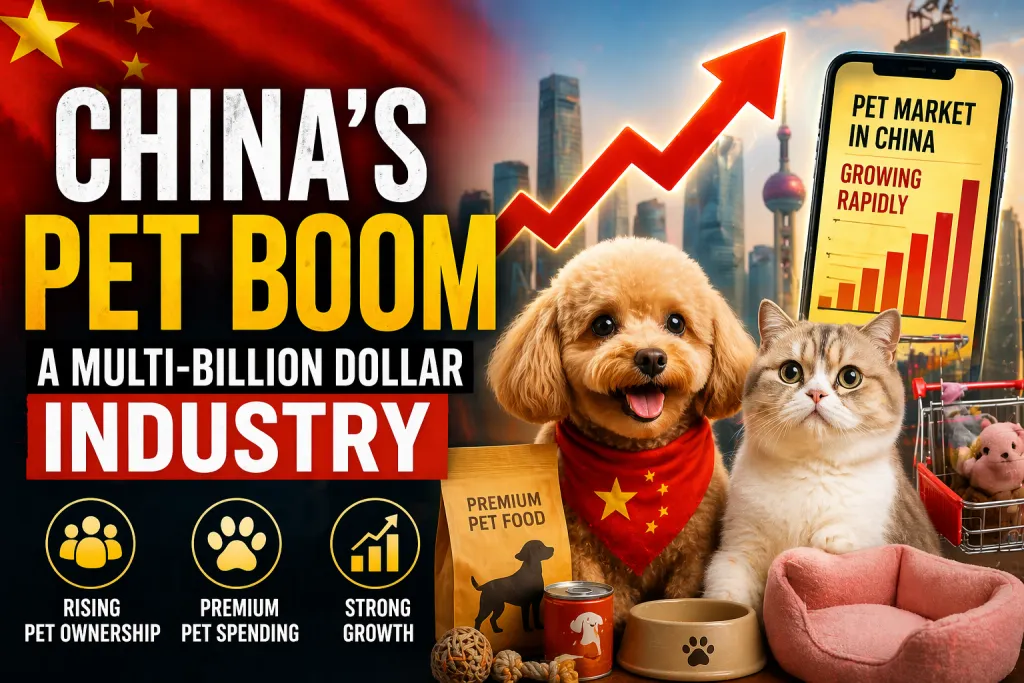
Walk into a dedicated pet mall in central Beijing today, and you won't find a shopper lamenting that their favourite imported brand is out of stock. More likely, you'll find them standing in front of a wall of domestically produced, beautifully packaged beef and chicken meals, comparing protein percentages and debating flavour varieties — for their dog.
This is the new face of Chinese consumer spending in 2026. In a domestic economy weighed down by a prolonged property crisis, stagnant wage growth, and persistent job insecurity, one category has defied gravity with almost reckless consistency: pet food. Annual pet food sales rose sixfold between 2014 and 2024, making the industry one of the brightest spots in the consumer sector of the world's second-largest economy. And right now, the story inside that market is not just one of growth — it is one of a fundamental power transfer from Western brands to homegrown Chinese players.
The Numbers Behind the Boom
To appreciate the scale of what is happening, start with the fundamentals.
In 2024, the total pet population in China reached 124.1 million — 52.6 million dogs and 71.5 million cats — continuing a trend of Chinese pet owners preferring cats over dogs. The number of pet cats rose by 2.5% to 71.53 million, while the pet dog population increased by just 1.6%, preference for cats is culturally significant: they fit better into the realities of young urban Chinese life — smaller apartments, longer work hours, no need for outdoor walks. The cat economy, in other words, is driving the next chapter of China's pet boom.
The compound annual growth rate of China's pet food market from 2013 to 2024 was 22.4%, far higher than the global average growth rate. China produced 1.9 million metric tons of pet food in 2025, up 17.9% from a year earlier — the fastest-growing segment of the animal feed industry. And critically, the current market penetration rate in China sits at around 20%, compared to over 90% in developed countries across Europe and North America — meaning the runway ahead is still enormous.
The category is not a niche. It is a structural growth story with decades left to run.
Why Chinese Pet Owners Keep Spending
Here is the paradox that confuses outside observers: Chinese consumers are pulling back on discretionary spending across almost every category — fashion, restaurants, holidays — but spending more on their pets. How?
The answer lies in the emotional role pets have come to play in modern Chinese urban life. "Pet owners are increasingly prioritizing the health and happiness of their animals," said Liu Xiaoxia, founder of PetData. "The growth in the urban pet market underscores a transformative shift in consumer behavior."
For millions of young Chinese — particularly those in their twenties and thirties navigating high property prices, delayed marriage, and competitive job markets — pets have become a primary emotional outlet. They are not just companions; they are dependents. And in that psychological framing, spending on pet food is not a luxury. It is an obligation. A deeply felt one.
This deeper emotional investment in pet care has driven a marked shift toward premium, clean-label products tailored to a pet's breed, age, and lifestyle. Pet health supplements were the fastest-growing segment in the latest market data, reaching nearly $536 million on over 20% sales and volume growth. Among functional subcategories, cardiovascular health products led at nearly 108% year-over-year growth, while weight management and eye care products expanded 79% and 55% respectively.
Chinese pet owners are not buying commodity kibble. They are buying nutrition plans.
The Local Brand Uprising
For most of the past decade, multinational giants — Nestlé's Purina, Mars' Royal Canin, Canada's Orijen — dominated China's premium pet food segment. They had the brand equity, the safety track record, and the aspiration premium that Chinese consumers historically attached to foreign goods.
That premium is eroding fast. And Chinese domestic brands are the ones doing the eroding.
Domestic brands among the top 10 staple food companies achieved 17.6% sales growth and gained 2.4 percentage points of market share, while international brands in the same tier declined 4% and shed 2.5 percentage points. International brands ranked 11 to 20 contracted 27.8%. The direction of travel is unmistakable.
How are local brands winning? On three fronts simultaneously: product quality, marketing velocity, and price.
On quality, the gap with international brands is closing rapidly. Domestic firms can reach more than 90% animal protein content in some cat foods, while many foreign brands still use plant proteins such as soy. That is a product specification argument that resonates immediately with informed pet owners — and Chinese pet owners, fuelled by social media and pet influencer culture, are becoming very informed very quickly.
Domestic players are also investing heavily in product R&D, incorporating traditional Chinese ingredients — such as goji berries or Chinese herbs — into pet nutrition. Traditional Chinese herbal ingredients in cat food grew 83.1% in the latest period, suggesting that the cultural localization of pet food — much like what happened in human food — is well underway.
On marketing, domestic brands have a native advantage. Local brands are enhancing their presence through targeted digital marketing, pet influencer partnerships, and AI-driven recommendations for pet nutrition. They understand Douyin (TikTok's Chinese counterpart) and Xiaohongshu (Little Red Book) not as afterthoughts but as primary sales channels. Digital-native players secured roughly 12–15% market share in 2024 by selling exclusively through Tmall, JD, and Xiaohongshu storefronts, where same-day delivery and data-driven personalisation nurture repeat purchase. Interactive livestreams strengthen community engagement that traditional mass-media advertising cannot match.
And on price — domestic brands simply win. Their cost structures are leaner, their supply chains are local, and their marketing costs are lower when working natively within Chinese digital platforms.
The Conglomerates Are Coming
Perhaps the most telling sign of the pet food industry's maturity is who is now entering it: China's biggest old-economy giants, looking for new growth as their legacy businesses plateau.
The list of new entrants reads like a who's who of Chinese industry. Kweichow Moutai — China's $260 billion national liquor maker — said it planned to develop pet food out of protein byproducts from its fermentation process. Pork producer Wens Foodstuff acquired pet food maker Qingdao Shuang'an Biotechnology. WH Group, owner of packaged pork giant Smithfield Foods, invested in Zhongyu Pet Food. Dairy companies Mengniu and Yili, as well as drugmaker Yunnan Baiyao Group, have also launched pet food lines.
This is not dabbling. This is strategic diversification at scale. These companies bring manufacturing muscle, distribution networks, raw material supply chains, and brand recognition that most pure-play pet food startups could never match. Their entry will accelerate consolidation, raise product quality floors, and potentially reshape the competitive landscape entirely within the next three to five years.
The Moutai angle deserves special attention. Here is a company whose core product — baijiu, China's national white spirit — is facing a younger demographic that drinks progressively less of it. Pivoting byproducts into high-protein pet food is not just clever; it is a textbook example of vertically integrated diversification. If the protein quality is competitive, Moutai's brand cachet alone could make it a credible premium pet food player.
The Western Retreat — and the Exceptions
Against this backdrop, global brands are struggling to hold ground.
Imported pet food under the relevant customs code accounted for $499.8 million in 2024, a year-on-year decrease of 11.4%. In the first two months of 2025, China's total pet food imports dropped another 10.4%. General Mills' Blue Buffalo brand wound down its China operations entirely in April 2026. A sales manager at Germany's Animonda Carny noted that sales of its German-made chicken cat food fell 30% in China last year. "It's like electronics or autos — more people are buying local brands these days," he said.
The parallel to electronics and autos is apt and worth lingering on. A decade ago, foreign smartphone brands dominated China. Then Huawei, Xiaomi, and OPPO happened. Five years ago, Volkswagen and Toyota commanded Chinese roads without serious domestic challenge. Then BYD, NIO, and Li Auto happened. The pet food industry appears to be following the same S-curve: international brands lead initially, domestic brands learn fast, improve quality, undercut on price, and eventually flip the market. The inflection point in pet food appears to be happening right now.
But not every Western brand is retreating.
Mars' Royal Canin remains China's top-selling pet food brand and is actually gaining share through what industry observers describe as an effective localisation strategy. "Royal Canin's strategy is to open factories to reduce costs and localise production. They also invested in pet-store distribution, educating vets and working with breeding centres," said one industry observer. "That era of foreign brands simply exporting or casually hiring an agent to drive sales is over."
Royal Canin's playbook is the template every surviving international brand will need to study. Localise manufacturing to close the cost gap. Build distribution relationships at the grassroots level. Invest in the ecosystem — veterinarians, breeders, pet hospitals — not just in consumer marketing. Treat China as a market to be built, not merely a market to be exported into.
The Regulation Elephant in the Room
Growth stories always have a shadow side, and China's pet food boom is no exception.
There are currently no national standards for the pet food industry, which is overseen by the Ministry of Agriculture. Pet food is not the same as animal feed — but that is how it is being categorised and regulated right now. The practical consequence is a regulatory framework designed for livestock production — focused on fattening animals for slaughter — being applied to products designed to optimise the health and longevity of companion animals. The objectives are fundamentally misaligned.
"There is a low threshold for making pet food; anyone can do it," warned Andy Wong, vice chairman at the China Association for Quality Inspection's pet food and supplies committee. That low threshold has enabled explosive market entry — but it also creates genuine consumer risk. Safety incidents in Chinese food supply chains have historically triggered sharp consumer confidence collapses, and the pet food industry is not immune to that dynamic.
China's State Administration for Market Regulation issued 847 violation notices and levied fines of over $3.3 million in 2024 for misleading health claims, prompting a wave of packaging revisions across the industry. Regulatory tightening is coming — and for brands that have been cutting corners on ingredients or nutrition labelling, it will be a painful reckoning.
For international brands with stringent home-country quality standards, tighter Chinese regulation is actually good news. It raises the floor of the market closer to the standards they already meet — and makes their quality claims more credible by contrast.
What Comes Next
The China pet food market is projected to reach nearly $33 billion by 2034, with growth driven by premiumisation, functional nutrition, and the continued expansion of pet ownership into lower-tier cities. China's pet population is projected to reach 300 million by 2035, driven by urbanisation, the ageing 'silver generation', and Generation Z entering the workforce.
The battlegrounds of the next chapter are already taking shape. Health and functional nutrition — pet supplements, therapeutic diets, breed-specific formulations — will be the high-margin frontier. Festival-themed packaging grew 47.5% for cats and 99% for dogs in a single year, pointing to the emergence of gifting culture around pets — an enormous opportunity for brands that understand Chinese festive consumption patterns.
And e-commerce will remain the central battlefield. Subscription bundles reduce inventory risk and deliver predictable cash flow, while interactive livestreams strengthen community engagement that traditional mass-media advertising cannot match. Consumer review ecosystems reward transparency and rapid product iteration, enabling startups to roll out new SKUs in as little as six weeks. In that environment, speed and digital intimacy matter more than legacy brand recognition.
The Bottom Line
China's pet food market is one of the most dynamic consumer stories on the planet right now — a $24 billion industry growing at double-digit rates inside an economy where most consumer categories are struggling to stay flat. It is reshaping the competitive playbook for both domestic and global brands, accelerating the premiumisation of animal nutrition, and offering a textbook case study in how Chinese consumer markets evolve: fast adoption, rapid quality improvement, aggressive localisation, and eventual market reversal.
For global food and consumer goods companies, the lesson of Royal Canin versus Blue Buffalo is already written on the wall. Localise genuinely or exit gracefully. There is no middle ground in a market moving this fast.
And for Chinese conglomerates from Moutai to Mengniu pivoting into pet food — welcome to the most quietly ferocious consumer category in the country. The pets are waiting.