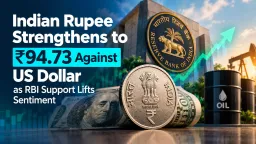
Why Is the Indian Rupee Falling in 2026? Causes, Consequences, and the Road Ahead

Every few months, the Indian rupee makes it back into the headlines. The number on the screen gets bigger — more rupees per dollar — and the commentary that follows tends to ping between two extremes: either a dramatic narrative about economic collapse, or a breezy reassurance that everything is fine and markets will sort it out.
Neither framing is especially useful.
What's happening to the rupee right now is genuinely complex, and understanding it properly requires looking beyond the daily exchange rate and into the architecture of forces that drive it. That means capital flows, commodity markets, interest rate differentials, geopolitical shocks, and the structural reality of India's external account. Let's work through each layer.
Where the Rupee Stands Today
The starting point is the raw data. The rupee depreciated approximately 9.88% against the US dollar in the fiscal year 2025–26, marking its sharpest annual decline in 14 years — the worst performance since the taper tantrum era of 2011–12.
The currency touched a historic low of 94.83 against the US dollar, driven by a combination of relentless foreign capital outflows and heightened market anxiety around escalating geopolitical tensions. Since the start of 2026, the rupee has fallen more than 5%, placing it among the weaker performers in Asia.
The pace of this decline is what makes it notable. Currencies move every day, and a gradual depreciation of the rupee against the dollar is historically normal — India has structurally higher inflation than the US, which over time tends to reflect in exchange rate movement. But a 10% fall in a single fiscal year is not a gradual adjustment. It is a signal that something more acute is at play.
The First Layer: A Structurally Strong Dollar
The starting point for understanding any emerging market currency movement right now is the US dollar — not because the rupee's story is entirely about America, but because the dollar is the gravitational centre of the global financial system. When it strengthens, almost everything else weakens relative to it, and emerging market currencies tend to feel it most sharply.
The US dollar strengthened significantly in this period, with the Bloomberg Dollar Spot Index trading at multi-month highs around the 99–100 level, putting broad-based pressure on most emerging market currencies, including the rupee.
Why does the dollar strengthen? Several reasons operate simultaneously. When geopolitical tensions rise globally, investors move toward safety — and the dollar is the world's most trusted safe-haven asset. When the US Federal Reserve maintains higher interest rates relative to the rest of the world, global capital gravitates toward dollar-denominated assets for yield. And when global growth outlook weakens, trade finance slows, reducing the flow of currencies that compete with the dollar.
Higher-for-longer US interest rates attract global capital toward US assets, strengthening the dollar and widening the interest rate differential, which drives foreign portfolio investment outflows from emerging markets like India.
The important point here is that when the dollar strengthens across the board, the rupee's weakness is not unique. Most emerging market currencies are falling simultaneously. But the rupee has fallen more than several peers — and that requires looking at India-specific factors.
The Second Layer: The Capital Flow Exodus
This is where the India-specific story begins in earnest. Foreign Portfolio Investors became aggressive sellers, pulling a record amount from Indian equity markets. The selling pressure intensified after the geopolitical conflict began in West Asia, with over $8 billion withdrawn in just three weeks. On a single day — March 19, 2026 — net FII selling on stock exchanges amounted to Rs. 7,558 crore.
FPI equity outflows of Rs. 1.8 lakh crore in FY26 through mid-April created persistent dollar demand. The mechanism is straightforward: when a foreign investor sells Indian equities, they receive rupees. To repatriate that money, they convert those rupees into dollars. That conversion increases the supply of rupees in the forex market and increases demand for dollars — a direct recipe for rupee depreciation.
It's worth noting what drove this investor's exit. FPIs have been net sellers of Indian equity markets mainly on account of tariffs reducing their confidence in India's growth prospects, and forward valuations of Indian equity markets standing at a premium relative to their long-term averages and to some emerging market peers.
In other words, the outflow is not simply a function of India-specific problems. It reflects a reassessment of India's relative attractiveness in a more uncertain global environment, where valuations had run ahead of fundamentals and where investors are now pricing in more risk.
Beyond portfolio flows, net foreign direct investment flows have also softened, turning negative for five consecutive months as of early 2026, largely due to elevated repatriation by foreign companies. FDI outflows are more structurally concerning than portfolio outflows, because FDI represents long-term investment conviction. When companies repatriate rather than reinvest, it signals a reassessment of India's medium-term economic environment.
The Third Layer: Oil, the Rupee's Oldest Adversary
India imports approximately 85% of its crude oil requirements. This single fact has shaped the rupee's vulnerability for decades, and it is acutely relevant right now.
Escalating fears of a prolonged energy supply crisis stemming from the ongoing conflict in West Asia have been a key driver of the rupee's fall. With Brent crude trading above $115 per barrel due to geopolitical tensions in the Middle East, India's import bill has surged, widening the current account deficit.
Here is the transmission mechanism: higher oil prices mean India must spend more dollars to buy the same amount of oil. This increases demand for dollars in the forex market, which pushes the rupee down. A weaker rupee then makes the same oil even more expensive in rupee terms, which feeds back into domestic inflation. This self-reinforcing loop is particularly uncomfortable to navigate and explains why oil price shocks hit India harder than most economies of comparable size.
India's large import volume is structurally one of the biggest reasons behind rupee depreciation. When India imports goods priced in dollars, it increases the supply of rupees internationally while simultaneously increasing demand for dollars, thereby decreasing the rupee's value.
This structural oil dependency is not something that changes quarter to quarter. It is a long-term feature of India's external account, which is why oil price spikes consistently show up as catalysts in any rupee depreciation story.
The Fourth Layer: Geopolitics as a Macro Force
Something that receives less attention in currency analysis than it deserves is the role of geopolitics as a direct market force. The West Asia conflict that escalated in early 2026 created a cascading effect: oil prices surged, risk sentiment deteriorated globally, capital fled to safety, the dollar strengthened, and emerging markets — including India — bore the brunt.
After starting the fiscal year on a weaker footing, the rupee's slide accelerated following the eruption of conflict in West Asia in February 2026. This event triggered a flight to safety, bolstering the US dollar and leading to aggressive selling in emerging markets. The rupee breached the 93-per-dollar mark for the first time in history on March 20, 2026.
Additionally, the stalled US-India trade deal and high US tariff rates — at around 50% for some Indian goods — dampened India's export competitiveness and further soured investor sentiment, contributing to persistent capital outflows throughout the year.
Trade deal uncertainty is particularly corrosive for currency sentiment because it introduces a multi-year overhang on India's export revenues. If Indian exporters face higher tariffs in the US — their largest trading partner — the earnings they would have brought home in dollars shrink. That structural reduction in dollar inflow, priced in gradually by markets, adds to depreciation pressure.
The RBI's Tightrope Walk
Where is the Reserve Bank of India in all of this? Its role has been active and consequential, but bounded by the realities of global macro forces.
Forex reserves, which hit an all-time high of $728.5 billion in the week ended February 27, 2026, fell to $709.8 billion in the week ended March 13, as the RBI sold dollars to slow the currency's fall. The RBI sold approximately $40 billion in reserves between late February and early April, drawing forex holdings from a record $728 billion down to $688 billion.
This intervention is significant. The RBI is not defending a specific exchange rate level — the RBI Governor has explicitly stated that India follows a market-determined exchange rate. The RBI Governor said, "We don't target any price levels or any bands. We allow the markets to determine the prices. We believe that markets, especially in the long run, are very efficient."
What the RBI is doing instead is moderating the speed of depreciation — preventing sharp, disorderly moves that could destabilize markets and trigger panic. There is a meaningful difference between gradual depreciation that allows businesses to hedge and adjust, and a sudden 5% move in a week that forces forced unwinds and compounds volatility.
In late March, the RBI announced a tightening of prudential norms, directing banks to ensure their net open forex positions do not exceed $100 million by the end of each business day, with a compliance deadline of April 10 — a measure intended to choke off speculative bets against the rupee.
The central bank is also constrained by another consideration. If the RBI raises interest rates aggressively to defend the rupee — making rupee assets more attractive for foreign investors — it risks slowing domestic growth at an already uncertain moment. Higher crude oil prices directly translate to fears of higher domestic inflation, which complicates the role of the RBI, potentially limiting its flexibility on interest rates. It's a classic central bank trilemma: price stability, exchange rate stability, and growth support cannot all be maximized simultaneously.
The Real Economic Consequences
Currency moves at the level of abstraction — a number on a screen — become very concrete once you trace them through the economy.
Inflation: A weaker rupee makes every import more expensive, and India imports a great deal of crude oil, edible oils, electronics, fertilizers, and capital goods. The RBI's April projections put FY27 headline CPI at 4.6%, more than double that of FY26's 2.1%. The quarterly path climbs, with a base case peak of 5.2% in Q3 FY27. A meaningful part of that inflation trajectory is imported inflation passing through a weaker rupee.
Interest Rates: Higher inflation constrains the RBI's ability to cut rates to support growth. Sectors such as real estate, NBFCs, and floating-rate lenders were positioned for further rate cuts. With a pause now as the base case, allocations against a "rates staying higher for longer" scenario need to be reviewed. In other words, the rupee's depreciation is indirectly raising borrowing costs for Indian households and businesses by constraining monetary easing.
Corporate Earnings: The sectoral impact is asymmetric, which is important to understand. Export-oriented industries — IT services, pharmaceuticals, specialty chemicals — earn in dollars and report in rupees. A weaker rupee directly expands their rupee revenues for the same dollar billing. Think of an IT company in Bengaluru. If it earns one million dollars from a US client, it receives more rupees today compared to two years ago. That extra income helps the company grow, hire more people and invest in new projects. Meanwhile, import-dependent sectors — aviation, paint, tyre, consumer electronics — face rising input costs that compress margins.
Equity Markets and Foreign Investors: The depreciation of the rupee is a double-edged sword for foreign institutional investors. While it could be a good entry point for Indian equities at lower dollar prices, investors simultaneously weigh the negative impact of protracted rupee weakness and trade policy uncertainty. In the near term, rupee weakness tends to exacerbate equity market volatility because it amplifies dollar-equivalent losses for foreign investors who are still holding positions.
External Debt: Companies and the government that have borrowed in foreign currency — dollar-denominated bonds — face a direct cost increase. Every rupee the currency depreciates means more rupees needed to service the same dollar interest payment or repay the same dollar principal.
What Happens Next: The Variables to Watch
Currency forecasting is inherently uncertain, but the variables that will determine the rupee's trajectory over the next 6–12 months are identifiable.
Crude oil prices remain the most direct lever. If geopolitical tensions in West Asia de-escalate and oil settles back below $90 per barrel, India's import bill shrinks, dollar demand eases, and the current account deficit narrows. That is the single most powerful relief valve for the rupee.
US monetary policy is the second major variable. If the Federal Reserve begins cutting interest rates — something markets are watching closely — the dollar weakens globally, and capital flows back into emerging markets. India, with its growth story relatively intact, would likely be a major beneficiary.
FII flows will respond to a combination of the above. As crude stabilizes and the dollar softens, the risk-off trade that has driven capital out of emerging markets begins to reverse. India's equity markets — which, even after the correction, retain structural attractiveness on long horizons — become more compelling to global allocators when the currency stabilization narrative takes hold.
The US-India trade deal is the wildcard. Any strengthening of the rupee largely hinges on a trade deal with the US. A concluded deal would simultaneously improve export competitiveness, restore FII confidence, and signal long-term dollar inflow stability — a powerful triple effect on the currency.
RBI's forex reserves provide a buffer. Even after recent drawdowns, India's forex reserves remain substantial enough to manage volatility even if not to reverse the underlying trend. The RBI's willingness and capacity to intervene will remain a stabilizing presence.
The Bigger Picture: Weakness or Adjustment?
Here is the question worth asking at the end of all this: Is what's happening to the rupee a sign of structural economic weakness in India, or a cyclical adjustment to a genuinely extraordinary set of external shocks?
The honest answer is mostly the latter, with some of the former.
India's domestic economic fundamentals — growth trajectory, fiscal position, banking sector health, services export competitiveness — remain broadly intact. The rupee's fall is not primarily driven by a deterioration in India's own economic performance. It is driven by a globalgeopolitical shock (West Asia conflict), a structural commodity dependency (oil), a global flight to dollar safety, and a recalibration of risk premiums by foreign investors responding to a very uncertain external environment.
At the same time, India's structural current account deficit — the fact that it consistently imports more than it exports — means the rupee is perpetually running on a deficit of dollar inflows relative to dollar outflows. In calm markets, this deficit is covered by FDI and FPI inflows. When those dry up under risk-off conditions, the deficit becomes visible, and the currency adjusts.
The rupee's real effective exchange rate for a 40-currency basket fell from 102.34 in February 2025 to 94.05 in February 2026, pointing to undervaluation. A comparison with the REERs of other emerging economies shows the rupee has been steadily depreciating in real terms, which makes Indian goods and services cheaper relative to those of peer economies and can improve export competitiveness.
In other words, the same depreciation that creates near-term pain — through imported inflation and investor anxiety — also plants the seeds of eventual competitiveness recovery. A weaker rupee, if sustained, incentivizes domestic manufacturing, makes Indian exports cheaper in global markets, and over time, can help rebalance the very current account deficit that contributed to the depreciation in the first place.
That recovery takes time. And the near-term costs — in inflation, in borrowing costs, in market volatility — are real and will be felt by businesses and households before any export competitiveness dividend arrives.
The Bottom Line
The rupee's slide past 94 — and at its worst point, 95 — per dollar is the result of a confluence of forces, not a single cause. A globally strong dollar. A geopolitical shock that sent crude above $110. Record FII equity outflows. Softening FDI. An unresolved US trade deal. And a central bank doing what it can to manage pace without exhausting its reserves or sacrificing growth.
For investors, the takeaway is to separate the signal from the noise. The headline number — 94, 95, whatever it is on a given Friday — is less important than understanding which underlying forces are driving it and whether those forces are changing. When oil stabilizes, when the dollar peaks, when the trade deal takes shape, the same currency that looks beleaguered today can recover faster than most expect.
For the broader economy, the message is more sobering: structural oil import dependency and chronic current account deficits make the rupee perpetually vulnerable to exactly the kind of external shocks that hit in FY26. Addressing those vulnerabilities — through energy transition, export diversification, and deeper domestic capital markets — is a multi-decade project. Until then, the rupee will remain sensitive to forces that originate far beyond India's borders.