What Are CFDs? Meaning, How They Work, Pros, Cons and Risks
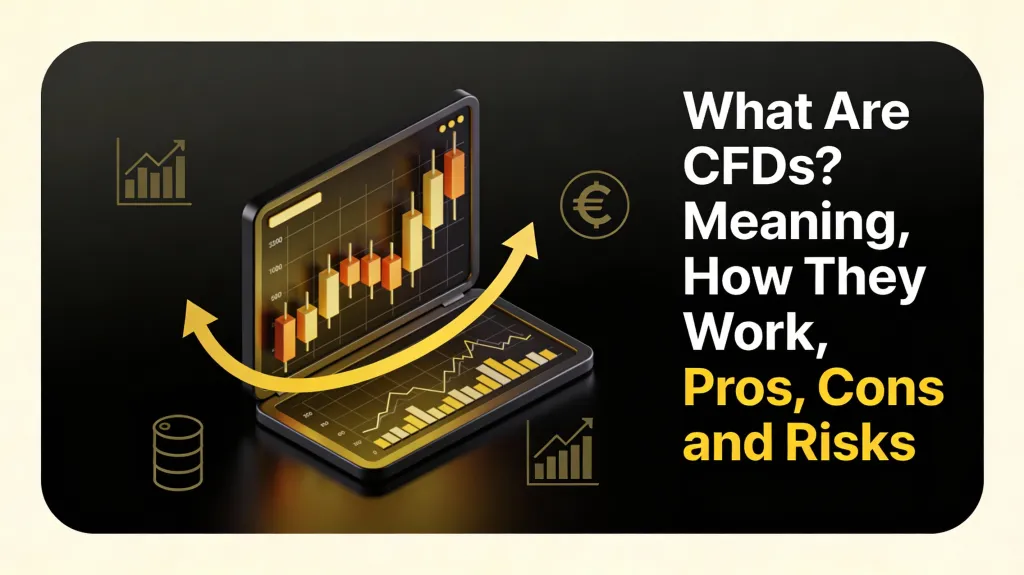
Contracts for difference, or CFDs, are derivative products that let traders speculate on price movements without actually owning the underlying asset. They are widely used in global markets for trading stocks, indices, forex, commodities, and even cryptocurrencies.
Basic CFD meaning
A CFD is an agreement between a buyer and a seller to exchange the difference between an asset’s price at the time the contract is opened and when it is closed. If the price moves in your favor you receive the difference as profit; if it moves against you, you pay the difference as a loss.
Unlike traditional investing, you never take delivery of the asset itself; you are only dealing in the price movement of that asset. This makes CFDs pure speculation instruments rather than ownership-based investments.
How CFDs work
When opening a CFD trade, you choose whether to go long (buy) if you expect prices to rise or go short (sell) if you expect prices to fall. Your profit or loss equals the price difference between entry and exit, multiplied by the position size.
CFDs are traded on margin, meaning you only deposit a fraction of the total trade value as collateral, while the rest is effectively financed by the broker. This use of leverage amplifies both potential profits and potential losses relative to your initial capital.
Key features of CFDs
Speculation on rising and falling markets through long and short positions.
Wide range of underlying markets including shares, indices, forex, commodities and more.
No fixed expiry in many CFD products; trades can often be held as long as margin and overnight conditions are met.
Most CFD trades are executed over the counter (OTC) with brokers, not on a centralized exchange. Contract size usually mirrors the underlying (for example, one share CFD often represents one share), though brokers can set their own contract specifications.
Advantages for traders
CFDs allow access to global markets with relatively small starting capital because of leverage and low minimum position sizes. Traders can easily diversify across assets such as equities, commodities and indices from a single trading account.
They also make short selling straightforward, enabling traders to attempt to profit from falling prices or hedge an existing portfolio. In addition, many brokers offer extended trading hours on CFDs beyond regular exchange sessions, which can appeal to active traders.

Major risks and drawbacks
Leverage is the biggest risk in CFD trading because even small market moves can cause large percentage losses on the margin you have deposited. In many jurisdictions, a large majority of retail clients lose money when trading CFDs, highlighting the complexity and risk of these products.
CFDs also involve ongoing costs such as spreads, overnight financing charges, and sometimes commissions, which can erode returns over time. Regulatory restrictions exist in some countries, and CFDs may even be banned for retail clients in certain markets due to their risk profile.