How Central Banks Shape the Economy, Markets & Your Money
The Invisible Force Behind Economic Stability
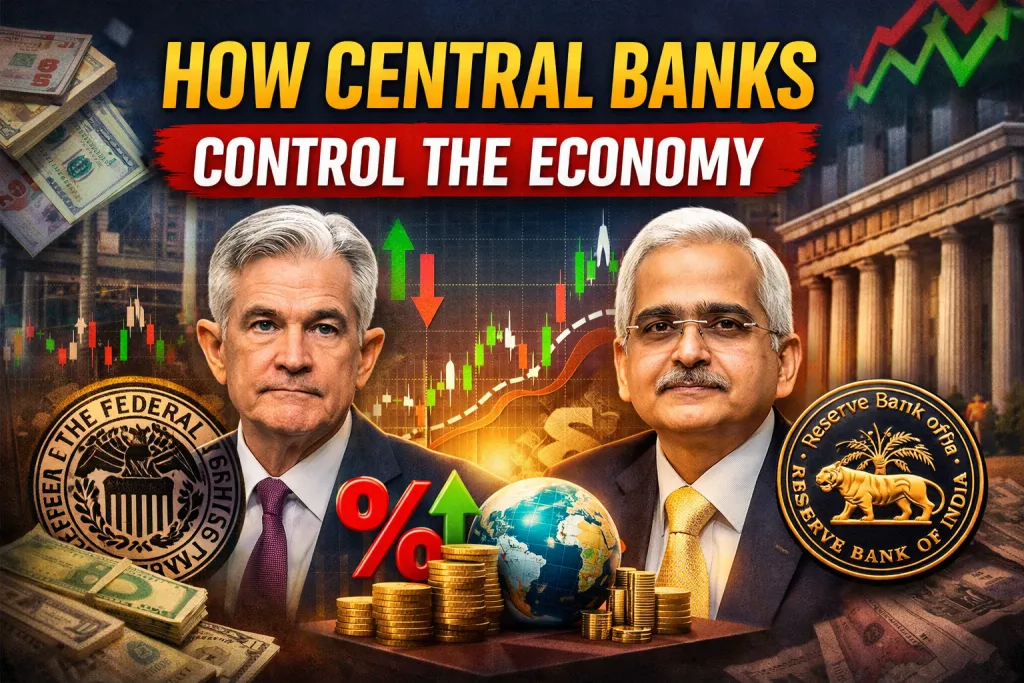
Every modern economy is quietly steered by its central bank—institutions like the Reserve Bank of India (RBI), the Federal Reserve, and the European Central Bank. While governments influence growth through fiscal policy, central banks shape the economy by controlling the cost and supply of money.
Their primary mandate is simple but critical: maintain price stability while supporting growth. In India, the RBI targets inflation at 4% with a tolerance band of ±2%. In the US, the Federal Reserve aims for around 2% inflation. These are not random numbers—they are carefully chosen levels that balance purchasing power with economic expansion.
When inflation in India surged to 7.8% in April 2022, well above the RBI’s upper band of 6%, the central bank had to step in aggressively. This is where monetary policy becomes the key tool.
Interest Rates: The Most Powerful Lever
The most direct way central banks control the economy is through interest rates.
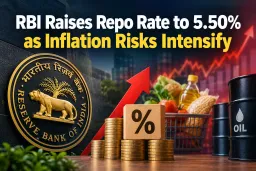
In India, the RBI uses the repo rate, which directly impacts borrowing costs across the economy. Between May 2022 and February 2023, the RBI increased the repo rate from 4.0% to 6.5%—a sharp 250 basis point hike. The objective was clear: reduce excess demand and bring inflation under control.
Here’s how it plays out in real life:
A home loan borrower sees EMIs rise
Companies delay expansion due to higher borrowing costs
Consumers cut discretionary spending
This slows down demand and eventually cools inflation.
A similar but larger-scale example can be seen in the US. The Federal Reserve raised interest rates from 0–0.25% in early 2022 to over 5.25% by mid-2023, one of the fastest tightening cycles in decades. This directly impacted global markets—US mortgage rates crossed 7%, tech stocks corrected sharply, and capital flows shifted away from emerging markets like India.
Liquidity Control Through Bond Markets
Interest rates are just one side of the story. Central banks also manage liquidity through open market operations (OMOs)—buying and selling government bonds.
During the COVID-19 crisis, the Federal Reserve expanded its balance sheet from around $4 trillion in 2019 to nearly $9 trillion in 2022. This massive liquidity injection helped stabilise markets and support economic recovery.
Similarly, the RBI conducted large-scale bond purchases and liquidity operations to ensure that the Indian financial system had enough cash to function smoothly during lockdowns.
But this comes with a trade-off. Excess liquidity often leads to inflation. That’s why, post-pandemic, central banks reversed course—selling bonds and tightening liquidity to absorb excess money from the system.
Credit Control: The Hidden Mechanism
Another less visible but equally important tool is controlling how much banks can lend.
In India, banks are required to maintain reserves through:
CRR (Cash Reserve Ratio): currently around 4.5%
SLR (Statutory Liquidity Ratio): around 18%
This means nearly 22–23% of deposits cannot be freely lent, limiting excessive credit creation.
If the RBI increases CRR, banks have less money to lend, tightening liquidity. If it reduces CRR, lending capacity increases, boosting economic activity.
This tool is particularly useful during periods of overheating or when financial stability is at risk.
Real-World Case Studies That Shaped Markets
Central banking decisions are not theoretical—they have real, visible consequences.
Take the 2008 Global Financial Crisis. The Federal Reserve slashed rates to near zero and introduced quantitative easing. Without this intervention, the financial system could have collapsed entirely.
Fast forward to COVID-19:
RBI cut repo rate to 4% (a historic low)
Loan moratoriums were introduced
Liquidity measures worth ₹20+ lakh crore were announced
These steps prevented widespread defaults and supported economic recovery.
In Europe, the European Central Bank even experimented with negative interest rates (-0.5%), effectively charging banks for holding excess reserves. This was done to push lending in a sluggish economy—an unconventional but powerful move.
Why Investors Closely Track Central Banks
For investors, central banks are arguably the single biggest market driver.
Consider this:
When rates fall → equities rise due to cheap liquidity
When rates rise → valuations compress
In 2020–2021, global liquidity drove massive rallies in stocks, crypto, and even speculative assets. The US stock market added over $10 trillion in market value during this period.
But in 2022, as rate hikes began:
Tech-heavy indices corrected sharply
Bond yields surged (US 10-year yield crossed 4%)
Emerging markets saw capital outflows
Even in India, rate hikes impacted sectors like real estate, auto, and banking differently—highlighting how monetary policy shapes sectoral performance.
The Balancing Act: Growth vs Inflation
Central banks operate in a constant balancing act. Tighten too much, and you risk a recession. Ease too much, and inflation spirals out of control.
For example:
India’s GDP growth remained above 6–7%, even during tightening cycles
Inflation gradually moderated from 7.8% (2022) to ~5% levels in 2024
This shows how calibrated policy actions can stabilise the economy without derailing growth.
Final Thoughts
Central banks don’t directly control businesses or consumers—but they control the environment in which all economic decisions are made. By influencing interest rates, liquidity, and credit, they shape spending, investment, and market sentiment.
In a globally interconnected world, their impact extends far beyond borders. A single rate hike by the Federal Reserve can influence capital flows into India, affect the rupee, and even move stock markets.
For anyone serious about finance or investing, tracking central banks is not optional—it’s essential. Because behind every market rally, correction, or economic shift, there is almost always a central bank decision playing a silent but decisive role.