Why Valuation Matters More Than Growth
There's a seductive story that gets told in markets every few years: find a company growing fast enough, hold it long enough, and the entry price will stop mattering. Revenue doubles. Margins expand. The stock goes to the moon. Just buy the growth — the numbers will catch up.
It's a story with just enough historical truth to be dangerous.
The harder, less glamorous truth is this: the price you pay on day one is, over a long enough horizon, the single most consequential decision you make as an investor. Growth can be spectacular and still deliver poor returns if you overpay for it. Meanwhile, a slow, unglamorous business bought cheaply enough can compound wealth quietly for decades.
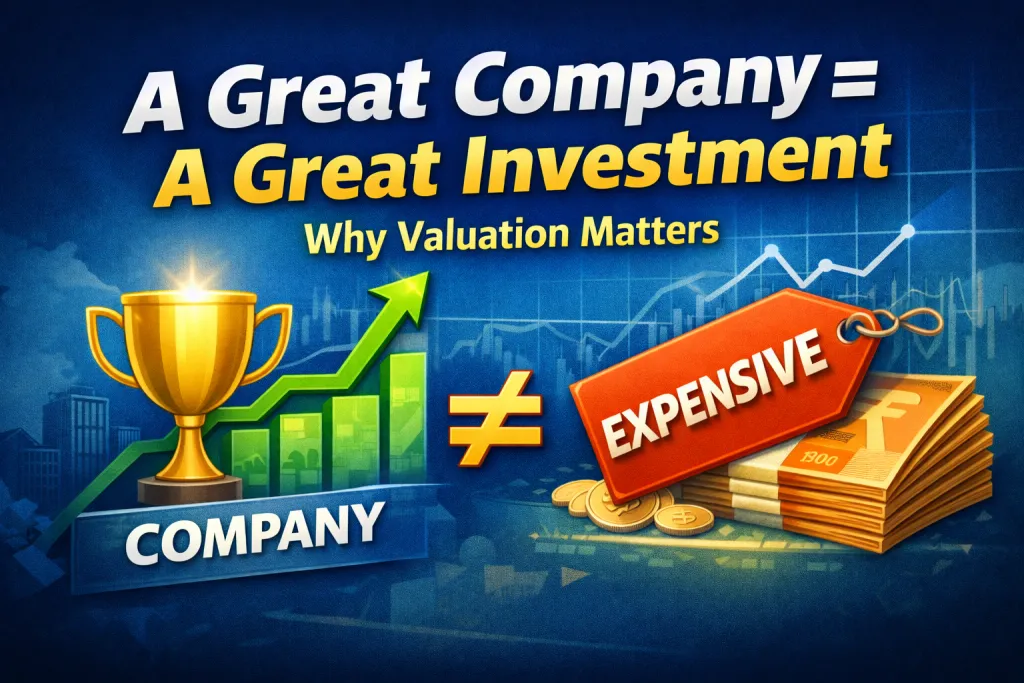
The Core Idea: A Great Company ≠ A Great Investment
These two things get conflated constantly, especially in bull markets. But they are fundamentally different.
A great company has strong fundamentals — high returns on capital, durable competitive advantages, growing revenues, and expanding margins. A great investment is a great company bought at a price that leaves room for you to profit. The difference between the two is valuation.
Think of it this way. If you buy a ₹100 note for ₹150, it doesn't matter how real the ₹100 note is. You've overpaid, and at some point, the market will make you feel that.
Warren Buffett put it simply: "Price is what you pay. Value is what you get." The gap between those two numbers is where your returns — or your losses — live.
The Math That Most Investors Ignore
At its core, every stock is worth the present value of its future cash flows. This is the Discounted Cash Flow (DCF) framework, and while it sounds technical, the underlying logic is simple:
Intrinsic Value = Sum of all future free cash flows, discounted at an appropriate rate
The discount rate reflects the risk of the business and the opportunity cost of capital. The higher the risk, the higher the rate — and the lower the present value of those future cash flows.
Here's where valuation becomes mathematically critical: when you overpay, you are effectively embedding a very optimistic growth story into your purchase price. Any slowdown — in revenue, in margin, in market share — doesn't just miss the target. It unwinds the entire valuation premium you paid.
A stock trading at 80x earnings is not expensive because someone said so. It's expensive because it has already priced in years, sometimes a decade, of flawless execution. There is no room for error.
The Dotcom Bubble: The Clearest Case Study
The technology bubble of 1999–2000 is the canonical proof point. Many of the companies that collapsed, Webvan, eToys — were genuinely addressing real markets with real demand. The vision wasn't entirely wrong. The execution failed, yes, but more importantly, the valuations were untethered from any rational cash flow math.
But here's the more interesting case: companies that survived and thrived were still terrible investments for years, simply because of the entry price.
Cisco Systems is the textbook example. In 2000, Cisco was the most valuable company in the world at one point. Its revenues were real. Its market position was dominant. The internet was, in fact, going to change everything. And yet, anyone who bought Cisco at its 2000 peak waited over 20 years just to break even. The business didn't fail. The valuation did.
This distinction matters enormously: the problem wasn't the company — it was the price.
Growth Rates Are Temporary. The Price You Pay Is Permanent.
One of the most seductive errors in investing is extrapolating growth rates indefinitely. A company growing revenues at 40% per year looks extraordinary. But growth rates revert. Always. The larger a company gets, the harder it becomes to sustain high growth simply because the base gets bigger.
Meanwhile, the price you paid on day one does not revert. It is locked in.
This asymmetry is what makes overpaying for growth so punishing. You pay a permanent premium for a temporary advantage. When the growth decelerates — not if, when — the market re-rates the stock downward, and you absorb a double hit: earnings grow more slowly, and the multiple the market assigns to those earnings compresses simultaneously. This is called multiple compression, and it can wipe out years of underlying business growth.
Consider a simple hypothetical: Company A grows earnings at 20% per year for five years, but is bought at 60x earnings. Company B grows at 10% per year but is bought at 12x earnings. By year five, even with meaningfully slower growth, Company B likely delivers superior returns — because the starting valuation gave you a margin of safety that Company A never did.
What the Data Shows
Research from J.P. Morgan Asset Management across decades of market data shows that value stocks — those bought at lower multiples relative to fundamentals — have delivered superior long-term returns compared to growth stocks, despite the popular perception that growth is where money is made.
The father of growth investing himself, T. Rowe Price Jr., did not believe growth should be bought at any price. He advocated for buying superior growing companies at reasonable valuations relative to that growth. The PEG ratio — Price-to-Earnings divided by the growth rate — emerged precisely from this idea. A PEG below 1 often signals that growth is being underpriced. A PEG well above 1 is a warning signal.
The lesson: even the inventors of growth investing understood that valuation sets the floor.
The Interest Rate Connection
Valuation's importance becomes even more stark in rising interest rate environments — which is exactly the environment markets have navigated since 2022.
Here's why: high-growth stocks derive most of their value from cash flows far out in the future — five, ten, fifteen years from now. When discount rates rise (driven by interest rates), those distant cash flows get discounted more heavily, and their present value collapses. This is not sentiment. This is mathematics.
Growth stocks that traded at 50–100x revenues in 2021 fell 60–80% through 2022–23, not because their businesses collapsed, but because the rate environment made their valuations arithmetically unsustainable. Value stocks and cash-generative businesses held up far better — because when you buy a business generating real cash flows today at a modest multiple, rising discount rates do far less damage.
The Margin of Safety Principle
Benjamin Graham — the intellectual godfather of value investing and Warren Buffett's mentor — introduced the concept of margin of safety in The Intelligent Investor. The idea is straightforward: buy assets at a significant discount to their intrinsic value, so that even if your assumptions are somewhat wrong, you are protected from permanent capital loss.
Margin of safety is, at its heart, a valuation concept. You cannot have a margin of safety if you are paying 80x earnings for a company whose future you are, by necessity, guessing at.
High valuations eliminate margin of safety. They transform investing into speculation — you are no longer protected by the business's fundamentals; you are entirely dependent on sentiment remaining elevated.
But What About Quality Compounders?
A fair objection: some of the greatest investments of all time — Infosys, Asian Paints, Titan, HDFC Bank in India; Apple, Microsoft, Amazon globally — did appear "expensive" by conventional metrics for long periods and still made investors extraordinary returns.
This is true. And it does not contradict the valuation argument. It refines it.
The reason these companies rewarded investors despite seemingly high multiples is that their growth was durable far longer than the market expected, their returns on capital were exceptional, and — critically — early investors bought them before the market had fully priced in that durability. The Infosys of 1995 was not expensive. The Infosys of 2000 was significantly more expensive. The return profile of those two entry points was dramatically different.
The lesson is not "valuation doesn't matter for quality businesses." The lesson is: quality businesses can justify higher valuations — but not unlimited valuations. Even the best company in the world can become a bad investment at the wrong price.
The Practical Takeaway for Investors
When evaluating any investment, ask these questions before asking how fast it is growing:
What am I paying for this business today relative to its earnings, cash flows, or assets? A P/E of 12x and a P/E of 60x are not just different numbers — they represent entirely different risk profiles and return expectations.
What growth rate is already embedded in this price? Work backwards from the current valuation. If the stock is pricing in 30% revenue growth for the next decade, ask honestly how likely that is.
What happens to my investment if growth disappoints? Model the downside. If even a modest miss causes a 40–50% drawdown, the asymmetry of risk is working against you.
What is my margin of safety? If everything goes right, how much do you make? If something goes modestly wrong, how much do you lose? The ratio of those two numbers is the real measure of an investment's attractiveness.
Conclusion: The Price You Pay Is the Return You Get
Markets are fascinating because they confuse narratives with fundamentals, especially in the short run. A great story about disruption, technology, or market dominance can keep a stock elevated for years beyond what the underlying numbers justify. And in that period, those who bet on story over substance can look brilliant.
But the mathematics of investing is patient. It does not forget what you paid. And over a full cycle — across bull markets and bear markets, booms and corrections — the evidence is unambiguous: investors who paid disciplined prices for businesses, regardless of whether those businesses were fast-growing or slow, outperformed those who chased growth at any cost.
The best investors in history — Graham, Buffett, Munger, Lynch, Templeton — each arrived at a version of the same conclusion through different paths: a business is only worth what it can generate in cash, and you should pay less than that.
Growth is exciting. Valuation is what determines whether that excitement translates into actual wealth. Buy the business, but never forget to check the price.