India’s IT Giants Face an AI Reckoning: Fiction Meets Financial Reality
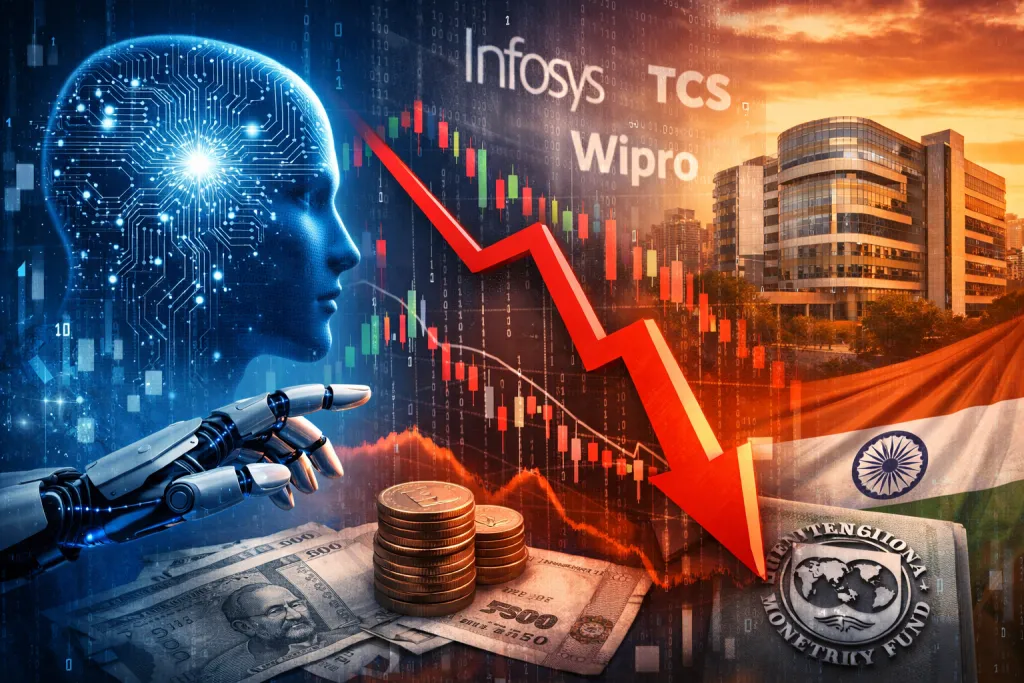
When a fictional report can erase billions from real valuations, it signals not just market volatility but a deeper anxiety about what technology is truly worth. The latest jolt came from Citrini Research, whose “imagined history”, a meticulously written future narrative, has shaken investor confidence in India’s biggest technology exporters, from Tata Consultancy Services (TCS) and Infosys to Wipro.
A Hypothetical Shock, Real-World Consequences
Citrini’s report, styled as a retrospective from the year 2028, painted a chilling portrait of a world where AI coding agents complete in minutes what once took India’s IT workforce thousands of hours. It envisioned cascading contract cancellations, a plunging rupee, and even whispered talks between New Delhi and the International Monetary Fund. The authors insisted it was a “thought experiment, not a forecast,” yet investors reacted as if prophecy had already begun unfolding.
Within days, the Nifty IT Index slumped to fresh 52‑week lows. In February alone, Indian IT firms collectively lost over ₹5 lakh crore in market capitalization. It’s not the first time a speculative narrative has rattled stocks, but it’s rare for one grounded in imagination, not analysis, to have this kind of market impact.
The Fragile Core of India’s Tech Advantage
For decades, India’s IT success rested on three pillars: a vast pool of English‑speaking talent, competitive labor costs, and a reputation for dependable execution. But as generative AI grows exponentially more capable, turning intricate software workflows into near‑instant code deployments, that model faces a structural test.
Citrini’s thought experiment struck a chord because it made a latent fear tangible. If AI can deliver software faster, cheaper, and with fewer errors than humans, what remains of India’s outsourcing superiority?
Leading brokerages such as Jefferies and CLSA have already trimmed their outlooks for large‑cap IT exporters, citing margin pressures, delayed deal cycles, and potential AI-induced redundancy. HSBC’s analysts, while more measured, note that even a “modest 15–20%” productivity jump from AI could meaningfully shrink demand for labor-based contracts.
Beyond Coding: The Coming Shift in Value
The real threat isn’t that code-writing disappears, it’s that the definition of value in technology shifts upward. As Alap Shah, co-author of the Citrini report, told Bloomberg: “The scarcity premium is moving from routine intelligence to creative judgment.” In other words, what clients will soon pay for isn’t raw output, but the wisdom to orchestrate automation efficiently, securely, and ethically.
That shift suggests a bifurcated future for Indian IT: one where commodity services compress sharply in value, while high-end consulting, AI integration, and data-governance domains command a premium. The winners, in this landscape, will not be those with the most engineers, but those who can reinvent themselves as architects of machine intelligence.
Reimagining India’s IT Identity
Market cycles come and go, but paradigm shifts redefine nations. India’s IT miracle turned college graduates into global problem-solvers and helped build the country’s forex resilience. Now, it faces a paradox: the very efficiency it once sold to the world can be replicated by an algorithm.
However, this is also a chance for reinvention. As the AI tide rises, Indian IT houses can transform their scale advantage into speed, building proprietary tools, investing in AI infrastructure, and training a new generation of “AI translators” capable of bridging technical power with business sense.
In an age when intelligence itself has become a commodity, the next big opportunity may lie not in coding tasks but in creative control, shaping how machines think, not merely teaching them what to do.
A Final Thought
Citrini’s “fiction from the future” might never unfold as written. But its timing is perfect: it has forced both investors and policymakers to confront the uncomfortable truth that the future of Indian IT is no longer guaranteed by inertia.
When narratives can move markets, imagination becomes the most valuable form of foresight. India’s IT leadership now faces a strategic choice - to wait for the script to play out, or to rewrite it before someone else does.