China, Hong Kong Markets Slip as Trump-Xi Optimism Cools; Property Stocks Defy Weak Trend
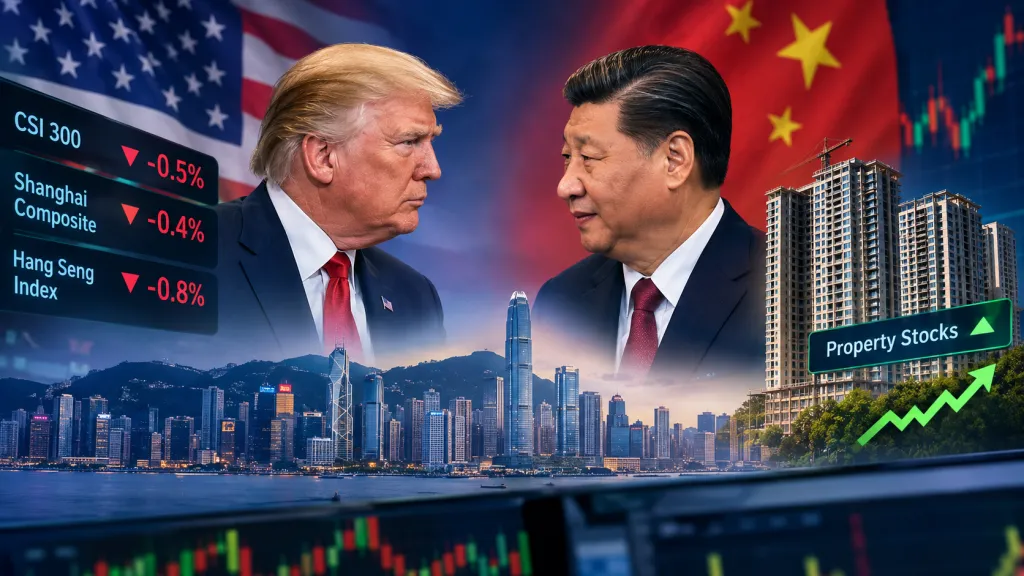
China and Hong Kong equities came under pressure on Wednesday as investors turned more cautious ahead of the upcoming meeting between US President Donald Trump and Chinese President Xi Jinping.
The pullback came after an earlier period of optimism had pushed investors to position for a potentially more constructive discussion between the world's two largest economies. With the September 24 meeting approaching, markets are now taking a more measured view of what the talks could deliver.
By the midday break, China's CSI 300 index was down around 0.5%, while the Shanghai Composite declined 0.4%. In Hong Kong, the Hang Seng Index slipped 0.8%
Why are Chinese stocks falling?
The main factor behind Wednesday's weakness was a reduction in expectations surrounding the Trump-Xi meeting.
Investors have been closely watching the summit for indications that the US and China could maintain or extend their existing trade truce. However, markets are increasingly aware that major disagreements over trade, technology and security policies remain unresolved.
Oxford Economics said the meeting could make the relationship between Washington and Beijing more predictable, while structural restrictions in trade, technology and security could continue.
This has encouraged investors to take some profits after the recent gains rather than aggressively increase exposure ahead of the meeting.
Europe-China trade tensions add to market pressure
Another concern for Chinese stocks is the growing friction between China and Europe.
European officials have raised concerns about the impact of China's expanding industrial capacity on European manufacturers. The European Central Bank recently highlighted pressure on European companies from China's industrial transformation.
The issue is particularly relevant for Chinese automobile manufacturers.
An index tracking Chinese automakers fell about 0.6%, while an index of new-energy vehicle companies declined by nearly 1% during Wednesday's trading. Calls in Europe for local-content requirements and broader trade restrictions have added to uncertainty for Chinese vehicle exporters.
Property stocks move against the broader market
While most major Chinese and Hong Kong benchmarks declined, property stocks moved in the opposite direction.
The property sector received a boost following reports that Chinese regulators had asked some banks to avoid classifying certain overdue loans linked to China Vanke as non-performing and to extend repayment timelines for the developer.
The development is significant because China's property market has been dealing with weak housing demand, high debt levels and a prolonged downturn.
Government support measures could therefore provide temporary relief to developers and financial institutions exposed to the property sector. However, the broader recovery of China's real estate market will still depend on factors such as homebuyer confidence, financing conditions and housing demand.
Technology rally starts losing momentum
Chinese technology stocks also showed signs of cooling after their recent gains.
Technology shares had benefited from renewed enthusiasm around artificial intelligence and expectations of greater communication between Washington and Beijing on AI-related issues.
On Tuesday, Chinese and US officials agreed to hold discussions related to AI safety, helping technology stocks maintain momentum.
By Wednesday, however, investors appeared more cautious as attention shifted back toward the broader trade and geopolitical relationship between the two countries.
What investors are watching next
The Trump-Xi meeting on September 24 remains the immediate market focus.
Investors will be looking for signals on whether the existing US-China trade truce can be extended and whether the two sides can reduce uncertainty around tariffs, technology restrictions and other economic issues.
At the same time, developments in China's property market and its trade relationship with Europe will remain important for Chinese equities.
For global investors, the latest moves highlight how sensitive Asian markets remain to developments between the world's two largest economies. Even positive diplomatic signals may not immediately remove the longer-term challenges surrounding trade, technology and economic policy.
Bottom line
Wednesday's decline in Chinese and Hong Kong stocks reflects cautious positioning rather than a single market shock. Investors are waiting for clearer signals from the Trump-Xi meeting while simultaneously assessing China's growing trade tensions with Europe and the government's efforts to stabilize the property sector.
The contrasting performance of property stocks also shows that China's market is being driven by different forces at the sector level, even as broader indexes remain sensitive to global trade developments.
Source context: Market data and developments above are based on reports published September 23, 2026, including Reuters reporting carried by Business Recorder and Economic Times.