UPI Charges From October 15, 2026: What You Need to Know
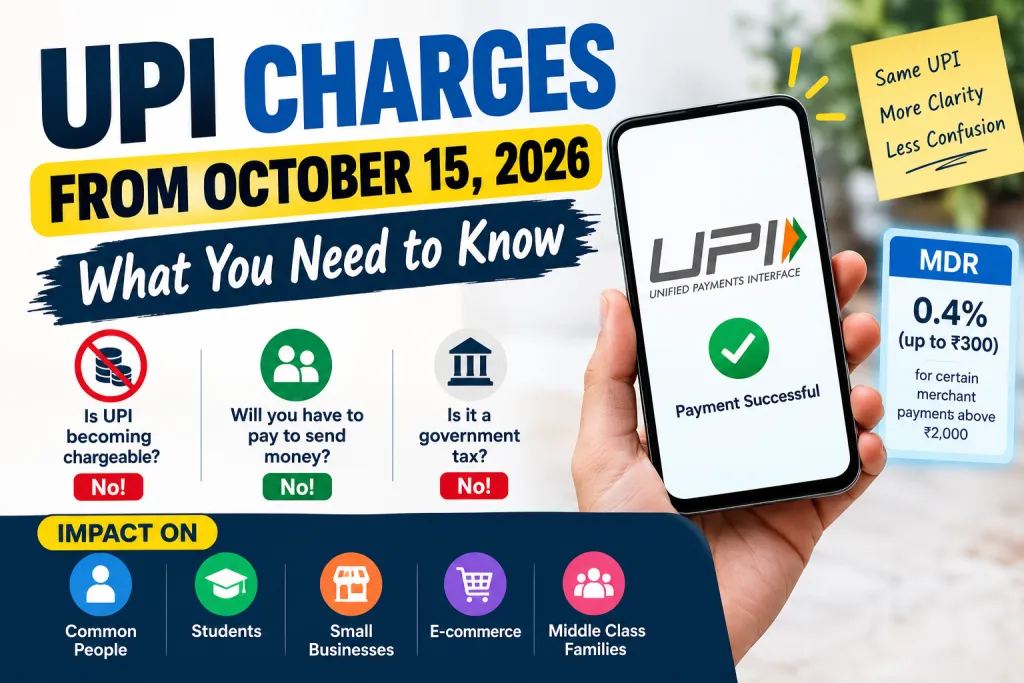
Is UPI becoming chargeable from October 15? Will you have to pay for sending money? Is the government imposing a UPI tax?
There has been a lot of confusion around the latest UPI rules. Social media posts are claiming that users will soon have to pay a fee on every UPI transaction.
That's not correct.
From 15 October 2026, a new Merchant Discount Rate (MDR) framework will apply to certain UPI payments made to merchants. It does not mean that every UPI transaction will become chargeable.
Here's what is actually changing.
What Is Changing From October 15?
Under the new framework:
Person-to-person UPI transfers remain free.
Merchant payments of up to ₹2,000 remain free under the standard framework.
Certain eligible merchant transactions above ₹2,000 will attract an MDR.
The standard MDR is 0.4%, with a maximum of ₹300 per transaction.
The MDR is a merchant-side payment-processing charge, not a government tax on consumers.
For example, if you make an eligible ₹5,000 merchant payment, the standard MDR would be:
₹5,000 × 0.4% = ₹20
That ₹20 is not supposed to be added to your bill as a separate UPI fee.
The government has also stated that around 96% of P2M (person-to-merchant) transactions will remain unaffected.
UPI Tax? No. That's One of the Biggest Rumours.
One of the most common claims online is:
"The government is introducing a UPI tax."
This is misleading.
MDR and tax are not the same thing.
MDR is a payment-processing fee within the digital-payment ecosystem. It isn't a tax collected by the government from consumers.
So if someone tells you that the government will deduct a percentage every time you send money through UPI, that's false.
Will You Have to Pay for Sending Money to Friends?
No.
The ₹2,000 threshold does not mean that you cannot send more than ₹2,000 through UPI.
For example:
₹5,000 to your friend → No new MDR
₹20,000 to your parents → No new MDR
₹50,000 between your own accounts → No new MDR
These are person-to-person transactions.
The new MDR primarily concerns specified person-to-merchant payments.
How Will This Affect Common People?
For most people, the immediate impact should be limited.
Everyday shoppers
If you're paying ₹200 for lunch, ₹500 for groceries or ₹1,500 for a small purchase, there is no standard MDR under the new threshold.
So your everyday UPI experience should largely remain the same.
Students
Students regularly use UPI to send money to friends, pay for food, transport, subscriptions and small purchases.
P2P transfers remain free, so sending ₹5,000 to a friend isn't suddenly going to attract a UPI fee.
However, students making larger payments to businesses should understand that the merchant category can determine whether MDR applies.
Middle-class families
The bigger question is high-value purchases.
Think about buying:
a ₹30,000 phone
₹40,000 furniture
a ₹25,000 appliance
a ₹10,000 restaurant bill
If the payment falls under an eligible merchant category, the merchant may have to bear MDR.
Consumers aren't supposed to be directly charged for it.
But there is a concern worth watching: businesses could potentially respond through pricing or discounts.
What About Small Businesses?
Small businesses are an important part of this policy.
Eligible small merchants can continue receiving certain UPI payments without MDR under the small-merchant framework.
This means your local shopkeeper should not automatically assume that every payment above ₹2,000 will cost them 0.4%.
Merchant classification matters.
This distinction is important because many social-media posts simply say:
"Every payment above ₹2,000 will be charged."
That's an oversimplification.
What About E-Commerce?
E-commerce businesses could feel the change more clearly because they process large volumes of higher-value transactions.
Imagine an eligible ₹10,000 purchase.
At 0.4%, the MDR would be ₹40.
For one transaction, that may seem small.
But if a company processes thousands of such transactions every month, the cost can become significant.
Businesses will therefore have to decide whether to absorb the cost, reduce margins, adjust discounts or make changes to their payment strategy.
For consumers, this could indirectly affect pricing over time.
Why Is the Government Allowing This?
The argument behind MDR is fairly straightforward.
UPI operates at enormous scale and requires continuous spending on:
cybersecurity
fraud prevention
infrastructure
technology
payment processing
customer support
The new MDR framework is intended to create a more sustainable economic model for parts of the UPI ecosystem.
But this is also where criticism of the decision is justified.
Why Is This Decision Being Criticised?
India's UPI system became hugely successful partly because it was simple and effectively free for users and merchants in everyday transactions.
Introducing MDR, even on selected transactions, raises legitimate concerns.
1. Could businesses eventually pass the cost to customers?
Even if merchants are not supposed to directly charge customers, businesses may respond to additional costs by changing prices or reducing discounts.
That needs to be monitored.
2. Could today's limited charge become tomorrow's wider charge?
The current framework has specific thresholds and categories.
But consumers may reasonably ask whether future governments or regulators could expand the system.
Clear rules and transparency will be important.
3. Could it encourage cash payments again?
One of UPI's biggest achievements has been making digital payments convenient for businesses and consumers.
If merchants begin preferring cash because of payment costs, it could weaken some of that progress.
The government should therefore ensure that MDR doesn't unintentionally discourage digital payments.
UPI Charges: Rumour vs Reality
Claim | Reality |
|---|---|
Every UPI transaction will be charged | ❌ False |
Sending money to friends will cost money | ❌ False |
UPI is getting a new government tax | ❌ Misleading |
Payments above ₹2,000 automatically cost consumers money | ❌ False |
Some eligible merchant transactions above ₹2,000 will attract MDR | ✅ True |
Standard MDR is 0.4% | ✅ Yes, for specified transactions |
Maximum standard MDR is ₹300 | ✅ Yes |
Consumers are directly charged MDR | ❌ Not under the announced framework |
The Bottom Line
The biggest takeaway is simple:
UPI is not becoming a paid service for everyone from October 15.
You can still send money to friends and family through UPI without a new transaction fee. Most everyday low-value merchant payments will also remain unaffected.
The major change is the introduction of MDR for certain higher-value merchant transactions.
At the same time, the government should be transparent about how this system evolves and ensure that payment costs don't eventually become hidden costs for consumers.
UPI was built around convenience, accessibility and low-cost digital payments.
The challenge now is to introduce a sustainable payment model without weakening those very advantages.
So, don't believe the viral posts saying "UPI tax is coming for everyone."
The reality is much more specific - and much less dramatic.