India’s Economy Is Strong, So Why Is the Stock Market Falling?

India's economy and its stock market are currently sending investors two very different signals.
Economic indicators remain relatively resilient, but Indian equities have been under pressure. The Nifty 50 has fallen significantly this year, raising an obvious question:
If the economy is still growing, why are stocks struggling?
The Great Disconnect
India continues to have strong growth drivers, including manufacturing, infrastructure spending, domestic consumption and credit growth.
However, the stock market does not simply track economic growth.
Share prices depend on future earnings, valuations, interest rates, foreign investment and investor expectations.
This means a healthy economy can exist alongside a weak stock market.
Foreign Investors Are Selling
One of the biggest pressures on Indian equities has been foreign portfolio investor (FPI) selling.
In the second half of September alone, FPIs sold around ₹21,745 crore from Indian equities, with financials, oil & gas, automobiles, telecom and metals among the sectors facing significant outflows.
When large overseas investors reduce their exposure, it can create additional pressure on stock prices-even when the underlying economy remains strong.
Oil Is Creating Another Problem
Crude oil has become another major concern.
Brent crude recently moved above $100 per barrel, increasing worries about India's import bill and inflation. A weaker rupee can make the situation more challenging because India imports a large portion of its crude requirements.
Higher oil prices can affect companies through increased transportation, energy and raw-material costs.
Higher Interest Rates Matter Too
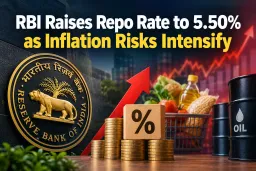
The RBI recently raised the repo rate to 5.50% and shifted its policy stance towards calibrated tightening.
Higher interest rates can make borrowing more expensive and can also make fixed-income investments relatively more attractive compared with equities.
This can put pressure on stock valuations, particularly companies whose prices already reflect high expectations for future growth.
Is This a Bad Sign for Long-Term Investors?
Not necessarily.
A falling market does not automatically mean that India's economic story is weakening.
In fact, market corrections can sometimes create opportunities for long-term investors—but only when valuations and business fundamentals are carefully examined.
The key question isn't simply:
“Why is the market falling?”
It is:
“Are good businesses becoming cheaper, or are their future earnings actually deteriorating?”
What Investors Should Watch Now
The upcoming corporate earnings season could provide an important answer.
Investors will be watching whether companies can maintain revenue growth and profitability despite higher oil prices, tighter financial conditions and global uncertainty.
For long-term investors, some of the most important indicators to track are:
Corporate earnings growth
Valuations
FII and DII flows
Crude oil prices
Rupee movement
Interest rates
Consumer demand
Corporate debt levels
The Bottom Line
India's current market situation is a reminder that the stock market is not the same thing as the economy.
A strong economy can still have an expensive market. And a weak market can sometimes contain attractive long-term opportunities.
For investors, the current correction may therefore be less about panic and more about reassessing valuations, earnings and business quality.
The next few quarters could reveal whether today's market weakness is simply a correction—or a longer period of adjustment.
This article is for educational purposes only and should not be considered investment advice.