Gold Prices Fall as Dollar Strengthens and Fed Rate-Hike Bets Rise; Oil Surges
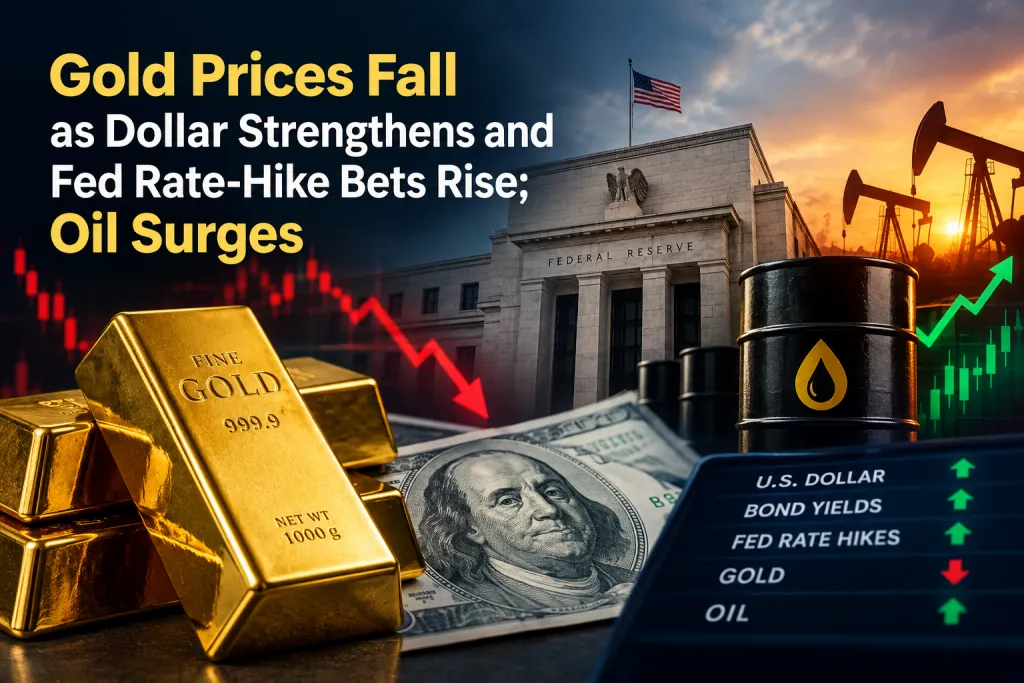
Gold prices came under pressure this week as a stronger U.S. dollar, rising Treasury yields and growing expectations of further Federal Reserve rate hikes reduced demand for the non-yielding precious metal. At the same time, oil prices have remained elevated amid geopolitical tensions, adding another layer of uncertainty for global markets.
The latest market moves highlight an important relationship between gold, interest rates, the U.S. dollar and crude oil—four factors investors are closely watching as inflation concerns return to the forefront.
Gold Under Pressure From Higher Rates
Spot gold was trading around $4,275–$4,300 per ounce on September 24, after falling more than 1% during the previous session. Reuters reported that gold was pressured by expectations that the Federal Reserve could tighten monetary policy further.
The pressure comes shortly after the Federal Reserve raised its benchmark interest rate by 25 basis points to a range of 3.75%–4% on September 16. The Fed said inflation remained elevated and that economic activity was expanding at a solid pace.
Higher interest rates generally make assets that generate interest more attractive compared with gold, which does not pay interest or dividends.
This creates a relatively simple market dynamic:
Higher rates → higher bond yields → stronger dollar → pressure on gold
Why Is the U.S. Dollar Strengthening?
The U.S. dollar has become another major headwind for gold.
The dollar index was holding near 101.1 on September 24, around a two-month high, after stronger-than-expected U.S. manufacturing data renewed concerns about inflation.
A stronger dollar makes dollar-priced commodities such as gold more expensive for international buyers. That can reduce demand and put downward pressure on prices.
The recent dollar strength is also linked to changing expectations around Federal Reserve policy. If investors believe U.S. interest rates could remain higher for longer, demand for dollar-denominated assets can increase.
Treasury Yields Add More Pressure
The bond market is also playing an important role.
A poorly received auction of five-year U.S. Treasury notes triggered additional selling in the bond market, with five-year Treasury yields moving above 5%, according to Reuters.
Bond prices and yields move in opposite directions. When investors sell bonds, their prices fall and yields rise.
For gold, rising yields can be negative because investors have more incentive to hold interest-bearing assets instead of a non-yielding commodity.
This is one reason the recent rise in Treasury yields has coincided with weakness in gold.
Oil Prices Complicate the Fed's Inflation Fight
Oil has become another major variable for financial markets.
Energy prices have remained elevated amid geopolitical tensions and uncertainty surrounding oil supplies. Higher crude prices can feed into transportation, manufacturing and consumer costs, potentially keeping inflation elevated.
That creates a difficult situation for central banks.
If higher oil prices lead to persistent inflation, the Federal Reserve may have less room to ease monetary policy. Recent comments from Fed officials have reinforced market expectations that another rate increase could be possible.
In other words:
Higher oil prices → inflation concerns → higher-rate expectations → stronger dollar and yields → pressure on gold
Why Gold Isn't Rising Despite Inflation Concerns
At first glance, falling gold prices may seem unusual because gold is traditionally considered a hedge against inflation and geopolitical uncertainty.
However, the current environment is more complicated.
Gold can benefit from inflation concerns, but if those concerns simultaneously cause markets to expect higher interest rates, the resulting increase in bond yields and dollar strength can outweigh some of gold's traditional safe-haven support.
This was visible in recent trading. Gold fell more than 1% on September 23 as hawkish Federal Reserve signals pushed the dollar to a two-month high.
What It Means for Investors
The recent movement in gold is a reminder that commodity prices are influenced by several factors at the same time.
Investors may want to keep an eye on:
Federal Reserve policy: Further rate hikes could increase pressure on gold.
U.S. dollar: Continued dollar strength could make gold less attractive internationally.
Treasury yields: Rising yields can increase the opportunity cost of holding gold.
Crude oil: Higher oil prices could keep inflation concerns elevated.
Geopolitical developments: Any improvement or deterioration in geopolitical tensions could quickly change demand for safe-haven assets.
Economic data: Inflation, employment and manufacturing data will influence expectations for future Fed decisions.
For Indian investors, movements in global gold prices are also affected by the USD/INR exchange rate, meaning domestic gold prices do not always move in exactly the same direction as international bullion prices.
The Bigger Market Picture
The current environment is being shaped by a tug-of-war between inflation fears and monetary tightening.
Gold is facing pressure from the combination of a stronger dollar and higher yields, while elevated oil prices are keeping inflation risks alive. Meanwhile, investors are trying to determine how aggressively the Federal Reserve may need to respond.
For now, the direction of gold is likely to remain closely connected to the path of U.S. interest rates, Treasury yields, the dollar and energy prices rather than any single factor.
Key Takeaway
Gold's recent decline does not necessarily mean the long-term investment case for the metal has disappeared. Instead, it reflects a shift in the short-term macroeconomic environment, where higher yields and a stronger dollar are competing with gold's traditional safe-haven appeal.
With oil prices, inflation and Federal Reserve policy all moving markets simultaneously, investors should expect continued volatility across commodities and currencies.
Sources: Reuters, U.S. Federal Reserve, Investing.com