Where Can You Invest Your Money in the US Market Right Now? Understanding the Great Rotation
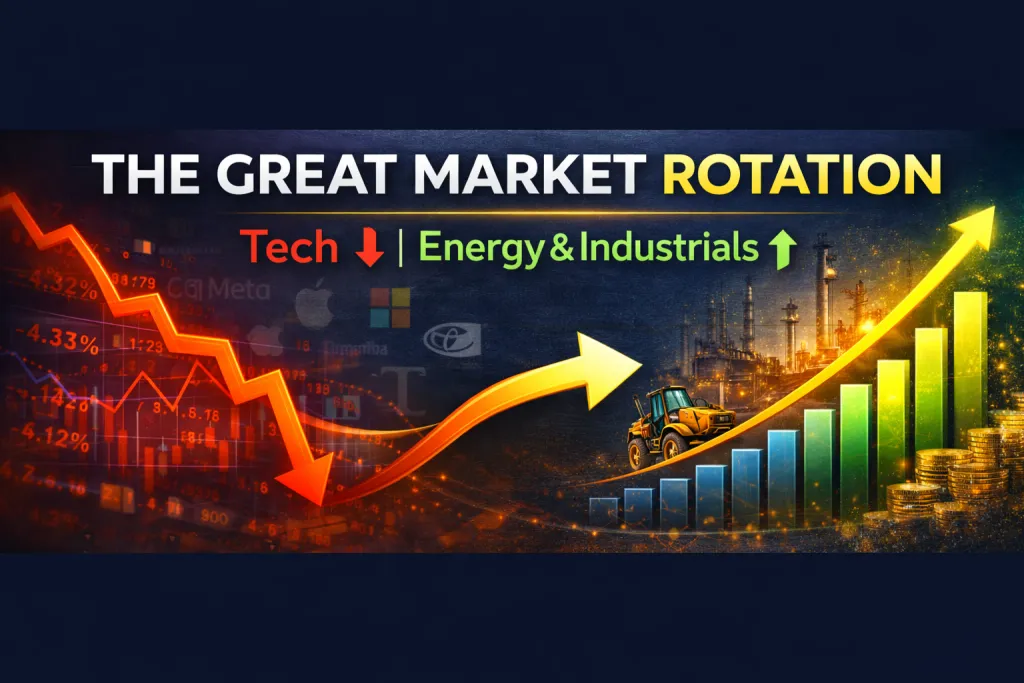
The US stock market in 2026 is not what it looked like a year ago. The playbook that worked between 2023 and 2025 — pile into mega-cap tech, ride the AI wave, collect returns — has been quietly losing its edge. A significant sector rotation is underway, driven by a convergence of forces: tariff-driven trade uncertainty, AI valuation fatigue, easing interest rates, and a macro environment that is increasingly rewarding companies with domestic revenue exposure, hard assets, and earnings that don't depend on promises about the future. Understanding where money is flowing — and why — is the starting point for any investor trying to position intelligently right now.
The Context You Cannot Ignore
Before looking at individual sectors, the macro backdrop needs to be understood. President Trump's aggressive trade policies have created significant volatility in equity markets, with the S&P 500 experiencing sharp swings as tariff announcements and geopolitical developments unfold. While trade tensions have pressured certain sectors — particularly technology, automotive, and consumer discretionary — companies with strong domestic revenue exposure, pricing power, and resilient business models are outperforming their globally exposed counterparts.
The tariff story has been disruptive. The Trump tariffs amount to the largest US tax increase as a percentage of GDP since 1993, representing an average tax increase per US household of around $1,500 in 2026. After a Supreme Court ruling in February 2026 struck down the emergency powers used to impose sweeping tariffs, the administration invoked Section 122 of the Trade Act of 1974, imposing a temporary 15% universal global tariff — a move that ignited fears of a prolonged multi-front trade war, sending shockwaves through global supply chains and forcing a massive strategic overhaul for investors who had bet on a more stable regulatory environment.
The immediate market consequence of all this has been a "Great Rotation." So far in 2026, energy stocks are up 21.5%, materials are up 17.6%, and industrials have climbed 12.3%. Technology stocks, by contrast, are down 3% for the year, while the Magnificent Seven stocks — Nvidia, Apple, Microsoft, Amazon, Alphabet, Tesla, and Meta — are collectively down 8.8%. This is not a blip. It reflects a structural shift in where institutional money is finding comfort in an environment defined by inflation risk, trade disruption, and slowing consumer sentiment.
Industrials: The Quiet Outperformer
The industrial sector has arguably been the most consistent theme in 2026, and the logic behind it is straightforward. Industrial stocks have gained more than 16% so far in 2026, with Caterpillar acting as the largest contributor, up 32% — investor perception of the company has evolved now that its generators are being used to help power the data centers that house AI servers. This is the key insight: you don't need to bet on who wins the AI race when you can bet on the infrastructure required to run it, regardless. Power generation equipment, construction machinery, and electrical infrastructure are all beneficiaries of the data center buildout that AI demands.
GE Vernova, an electric power firm spun off from General Electric in 2024, is also responsible for significant gains in the industrial sector. Analysts note the company is well-positioned to deliver material margin expansion as global economies transition to sustainable energy, potentially reaching $100 billion in annual sales with 21%-25% operating margins. The combination of AI infrastructure demand and the broader energy transition creates a multi-year structural tailwind for this sector that is unlikely to dissipate regardless of short-term trade noise.
The risk to watch is that some of the biggest names in industrials — Caterpillar included — have been caught between two forces: benefiting from AI infrastructure demand on one side, while absorbing higher input costs from steel and aluminum tariffs on the other. Caterpillar reported a 9% drop in operating profit due to $1.03 billion in manufacturing cost headwinds directly tied to steel and aluminum tariffs. This is why stock selection within the sector matters more than simply buying the ETF.
Energy: The Geopolitics Play
Energy is the 2026 story most directly shaped by geopolitical events rather than earnings fundamentals. Several factors are driving energy's outperformance: US foreign policy developments have led investors to believe that major oil companies may gain access to Venezuela's oil reserves, which at 19.4 billion barrels are considered the world's largest. Rising US-Iran tensions have also buoyed crude oil prices.
Beyond the geopolitical catalyst, domestic commodity producers and energy companies have been thriving under the tariff regime. US Steel and Nucor have both benefited from 50% Section 232 tariffs on foreign steel, which have remained untouched by recent court rulings. These are companies with inherently domestic revenue bases, which is precisely the characteristic the current market environment rewards.
The caveat with energy is its sensitivity to policy reversals. If geopolitical tensions ease or oil supply increases materially, the sector's gains could unwind quickly. Oil now carries more weight than many tariff headlines because higher fuel and shipping costs can move through the global economy quickly, pressuring household spending, squeezing business profit margins, and lifting inflation expectations in a short period. This cuts both ways — oil is a tailwind for energy stocks but a headwind for the broader economy, and at some point that tension resolves itself.
Healthcare and Biotech: The Deep-Value Opportunity
This is perhaps the most interesting sector for investors with a 12-to-24-month horizon, because the setup is unusual. Healthcare has underperformed the broader market for most of the last few years, weighed down by policy uncertainty around drug pricing and regulatory instability at the FDA. That underperformance has created a valuation opportunity that analysts are increasingly pointing to.
Healthcare stocks approach 2026 trading at some of the lowest relative price-to-earnings ratios in the sector's history compared to the broader S&P 500. At the same time, fundamentals have started to improve, from better clarity around drug pricing reform to an uptick in merger and acquisition activity. The specific opportunity within healthcare lies in biotech, and the driver is a phenomenon called the patent cliff. Over 200 drugs are set to lose their patent protection in the coming years, including at least 69 blockbuster drugs with annual sales exceeding $1 billion each, with a cumulative projected loss in sales exceeding $300 billion. This creates enormous urgency for large-cap pharma companies to acquire smaller biotech firms with promising drugs in their pipelines, which is why M&A activity is running hot.
According to William Blair analysts, 2025 recorded the most deal volume for the biotech sector in the last decade, with just under 70 deals with a disclosed value of $20 million or more. Large pharma and large-cap biotech companies collectively hold approximately $1 trillion in cash reserves available for M&A deployment, and the falling interest rate environment is encouraging them to put that capital to work. For investors, the strategy is to identify small and mid-cap biotech companies with drugs in Phase II or Phase III of the FDA approval process — these are the most likely acquisition targets, and a buyout typically comes at a significant premium to market price.
The risk in biotech is non-trivial. Regulatory uncertainty at the FDA persists, clinical trial outcomes are binary by nature, and individual drug failures can be devastating for single-company bets. Diversification through a basket of names or a sector ETF is a more prudent approach for most investors.
Financials: The Rate-Cut Beneficiary
Financial stocks represent the most conventional "sector rotation" play in the current environment, and the thesis is not complicated. Finance stocks are expected to do well in 2026 regardless of which direction interest rates move, but with the scale tilting toward at least one rate cut in the first half of 2026, lower interest rates will stimulate the economy and prove more supportive of bank earnings. The Federal Reserve cut its policy rate three times in late 2025, and further easing is expected through 2026, which reduces funding costs for banks and generally improves lending conditions.
The nuance here is that at the index level, the largest financial stocks — JPMorgan Chase, Berkshire Hathaway — are trading at or slightly above the sector's forward price-to-earnings ratio of around 16.5x. The real opportunity, analysts say, lies in individual stock selection among names that still trade at a discount to sector norms. Banks with strong domestic consumer loan books and minimal global supply chain exposure are better positioned than those with heavy international operations, for the same reasons domestic industrials are outperforming their globally-exposed peers.
What About Tech?
It would be incomplete to write about US sector investing without addressing the elephant in the room. Technology has not become a bad sector — it has become an expensive one with near-term headwinds. The velocity of innovation and growth in the AI sector is simply too high to ignore; the productivity revolution underway is fundamentally reshaping the global economy. For long-term investors, the opportunity cost of exiting too early is meaningful — consider the dot-com era, when an investor who sold tech stocks in 1997 because they looked expensive missed the structural gains of the following three years.
The technology sector, which represents approximately 29% of the S&P 500's weight, faces unique challenges from tariff policy and trade restrictions. Many technology companies rely on complex global supply chains with critical components sourced from China, Taiwan, and other targeted jurisdictions. Growth-oriented technology stocks are also particularly vulnerable to the higher discount rates that accompany inflationary environments. The near-term path for tech is choppy, but abandoning it entirely in a long-term portfolio would be a mistake.
The Bottom Line
The defining investment logic of 2026 is domestic over global, tangible over speculative, and discounted over expensive. Sectors with pricing power, hard assets, and revenue that don't depend on global supply chains are outperforming. The rotation from tech into industrials, energy, consumer defensives, and healthcare is not a temporary blip — it reflects a genuine reassessment of risk in an environment where trade policy can shift markets overnight.
For investors, this means the most productive positioning is not picking one sector and concentrating there, but rather recognising that market leadership has broadened meaningfully from where it was two years ago. The AI infrastructure buildout is real and continues to benefit industrial and utility companies even as it pressures the hyperscalers themselves. The biotech M&A cycle is creating specific stock-level opportunities in healthcare. And energy, for as long as geopolitics stay elevated, offers a hedge that few other sectors can match.
As always in investing, the caveat is timing. Many of the best-performing sectors of 2026 so far — energy, industrials, consumer defensives — are no longer cheap on an absolute basis. The discipline required is to identify the sectors with the most durable structural drivers and find the specific names within them that haven't already been fully re-rated by the market.