How Nayara Energy’s Shutdown Could Tighten India’s Fuel Supply?
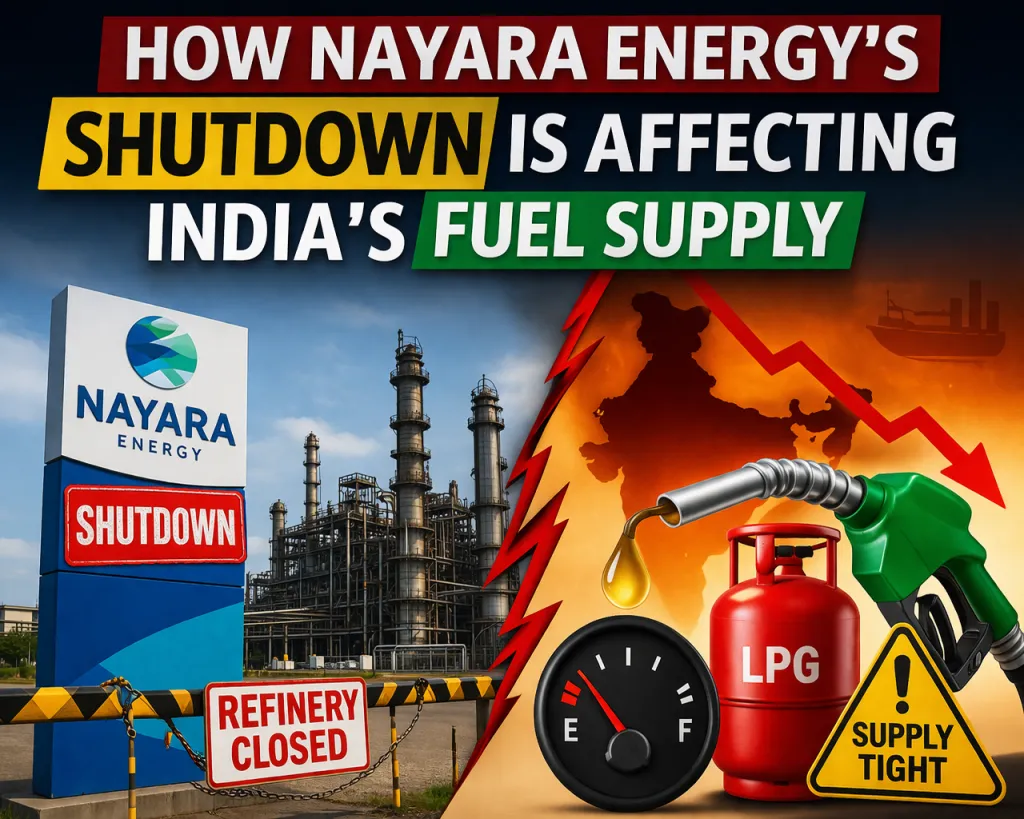
India's energy system doesn't often make the news for the right reasons. But right now, a single refinery preparing to go dark is drawing attention from industry analysts, government officials, and supply chain watchers alike.
Nayara Energy's Vadinar refinery, India's second-largest single-site refining complex, is set to shut down for approximately 35 days beginning early April 2026 for scheduled maintenance. On paper, that's a routine turnaround, but in practice, the timing couldn't be more awkward.
To understand why this matters, you need to look at what's happening not just inside the refinery gates, but across the full energy landscape India is navigating right now.
What's Actually Happening at Vadinar
The Vadinar refinery, located on the Gujarat coastline near Dwarka, processes around 4,00,000 barrels of crude oil per day, roughly 20 million tonnes annually. That makes it not just India's second-largest single-site refinery by throughput, but one of the most complex refineries in the world, with a Nelson Complexity Index of 11.8. When a facility this sophisticated goes offline, even temporarily, the supply chain downstream feels it.
The maintenance was originally planned for February 2026 but was pushed to April after European contractors declined to work with Nayara, owing to the sanctions the EU imposed on the company in July 2025. Nayara is 49% owned by Russia's Rosneft PJSC, and Brussels sanctioned it as part of efforts to restrict revenue funding Russia's war in Ukraine. The practical consequence: firms like Germany's Siemens AG and Denmark's Topsoe A/S, historically key technology and equipment partners, have stepped away, forcing Nayara to find alternative contractors, which took several months.
Why the delay matters
Indian refineries typically undergo full overhauls every four years, with operators carefully coordinating schedules to prevent fuel shortfalls. Nayara's last major maintenance was in November 2022, making this turnaround not just overdue, but safety-critical. Deferring it further would introduce real operational risk.
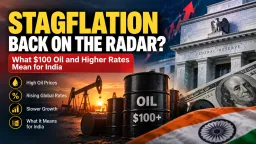
India imports over 88% of its crude oil and over 90% of LPG shipments historically transited through the Strait of Hormuz, now a geopolitical flashpoint.
The Bigger Problem: This Isn't Happening in Isolation
Here's the part the headline numbers don't capture. The Vadinar shutdown is arriving in the middle of one of the most complicated energy moments India has faced in years. Three simultaneous stressors are compressing the system at once.
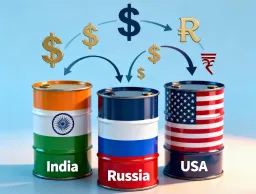
First, Russian crude imports are set to hit a four-year low. Nayara, post-sanctions, lost access to term crude contracts from Gulf suppliers and Western trading firms. It now runs almost entirely on Russian Urals crude supplied by its parent Rosneft. According to shipping data and analyst estimates, the shutdown will slash Russian crude imports by around 400,000 barrels per day in April, potentially pushing total Russian crude purchases below 500,000 bpd, the lowest level since April 2022, one month after the invasion of Ukraine.
Second, India is in the middle of an LPG supply crisis. Since late February 2026, conflict in West Asia and disruptions in the Strait of Hormuz have severely choked LPG flows into India. With roughly 60% of India's LPG coming from imports and over 90% of those imports historically routed through Hormuz, the country was left scrambling. By mid-March, India held LPG stocks covering only around 10 days of consumption, with domestic production unable to close the gap quickly. LPG is just 4-5% of a typical refinery's output and can't simply be scaled up on demand.
As many as 60% of restaurants could shut within 2–3 days if commercial LPG cylinder deliveries are not restored, as per a previous report by the National Restaurant Association of India (NRAI), March 2026
Third, India's overall crude import volumes have declined sharply. India's strategic petroleum reserves currently sit at roughly 64% of total storage capacity, enough for around 9–10 days of full import stoppage on its own, though the total buffer, including refinery stocks and private inventories, extends to an estimated 70–74 days. That's not zero cushion, but it's thinner than policymakers would like heading into a period where one major refinery is also going dark.
Note: Industrial gas supply infrastructure: India's LPG storage covers only around 10 days of consumption. India's LPG storage infrastructure can cover only a few days of consumption under normal demand, leaving it critically exposed when global shipping routes face disruption.
Will There Be Fuel Shortages?
For petrol and diesel, almost certainly not. India operates 23 crude oil refineries with a total refining capacity of approximately 258 million tonnes per year. The system is built with redundancy. When one facility goes offline, others can ramp up. Nayara has also reportedly pre-built buffer product inventories before the shutdown, and state-run refiners like Indian Oil, BPCL, and HPCL have the headroom to compensate. The government has also ordered refiners to maximize LPG output by diverting propane and butane streams, a directive that resulted in roughly a 25% rise in domestic LPG production, though that still falls well short of the import gap.
But "no immediate shortage" is not the same as "no impact." Even a modest tightening of available supply creates real downstream effects: logistics margins compress, regional pricing can become unpredictable, and distribution networks dependent on Nayara's supply chain, including nearly 7,000 petrol pumps under the Nayara brand, need to reroute procurement. In energy markets, tightness is often experienced first at the edges, in smaller cities and regional supply chains, before it shows up in headline data.
The Geopolitical Layer Nobody Can Ignore
What makes this moment structurally unusual isn't just the Vadinar shutdown itself. It's the convergence of factors:
EU Sanctions on Nayara (July 2025): Removed access to Western contractors, Gulf crude suppliers, and traditional trade finance — forcing a near-total dependence on Rosneft-supplied Russian Urals.
Strait of Hormuz Disruptions (Feb–March 2026): US-Iran-Israel conflict effectively choked LPG and crude flows from the Gulf, cutting off the route through which India receives 90%+ of its LPG imports.
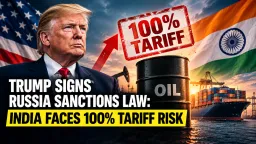
Trade Uncertainty (March 2026): A potential India-Russia trade deal — which could have stabilized some energy flows remains delayed following US Supreme Court rulings limiting Trump-era tariff powers.
Vadinar Shutdown (April 2026): 35-day maintenance begins as the country's Russian crude imports are already at a four-year low and domestic LPG stocks remain critically thin.
Each of these events, in isolation, would be manageable. Together, they describe a system under compounding stress, not collapse, but not comfortable either.
The Bottom Line
A 35-day shutdown will not break India's energy supply. The country's diversified refining base, strategic reserves, and policy flexibility, including emergency directives to maximize LPG output and diversify crude sourcing from 41 countries, give it meaningful shock absorption. Prime Minister Modi told the Rajya Sabha last week that the country's strategic reserve capacity is being expanded and that India now sources crude from nearly 41 nations, up from 27 earlier. That breadth matters.
But the Vadinar closure is a useful reminder of something that India's energy planners would prefer not to confront too openly: the country's energy security rests on a set of assumptions, stable shipping lanes, functioning contractor relationships, diversified credit lines, and steady geopolitical conditions that are no longer holding simultaneously. When they all happen at once, even a routine maintenance shutdown stops being routine.
In energy markets, stress rarely announces itself. It compounds quietly, one ripple at a time, until you're managing four crises that were each supposed to be manageable on their own.
The 35 days will pass, and the refinery will restart. But the structural questions this episode surfaces, about India's LPG import dependence, its over-reliance on Hormuz routing, and its deepening entanglement with sanctioned Russian energy, will outlast the shutdown by far, and that's what makes this moment worth watching closely.