FIIs Pull Out Over ₹11,700 Crore in January: What’s Driving the Foreign Investor Exodus?
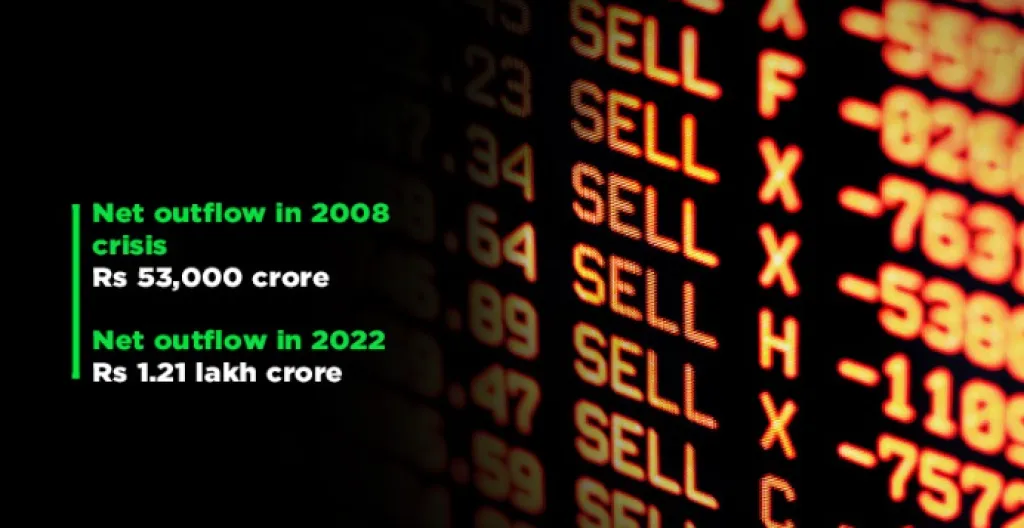
Foreign institutional investors (FIIs), also known as foreign portfolio investors (FPIs), have net sold more than ₹11,700 crore worth of Indian equities so far in January 2026. This trend of sustained sell-offs comes on the heels of significant outflows in 2025 and has contributed to downward pressure on major Indian stock indices, raising questions about market sentiment and future inflows.
January Outflows: Numbers That Stand Out
Data compiled from exchange and custodial sources show that FIIs sold around ₹11,789 crore worth of Indian shares in the opening weeks of January, continuing a pattern of net selling that extended into the new year.
This selling comes after an exceptionally large outflow in 2025, when FIIs pulled out a record sum of foreign investment from Indian markets. Strong domestic buying by mutual funds and retail investors has so far helped cushion broader declines, but the return of foreign selling has weighed on benchmark indices like the Sensex and Nifty.
Key Reasons Behind the FII Sell-Off
1. Global Trade and Tariff Concerns
One of the foremost factors cited by analysts is heightened uncertainty around global trade relations, particularly between India and the United States. Renewed tariff threats and a lack of clarity on a comprehensive trade agreement have unsettled foreign investors, leading many to reduce risk exposure.
Tariff tensions can have far-reaching implications for export-oriented sectors, affecting earnings projections and prompting portfolio reallocations away from markets perceived as riskier.
2. Geopolitical and Macro Uncertainty
Ongoing geopolitical tensions and conflicts across regions such as the Middle East and Latin America have amplified risk aversion among global investors. When geopolitical risks rise, capital typically flows toward safer assets such as U.S. treasuries or gold, and out of emerging markets like India.
Geopolitical headlines often play out rapidly in global capital markets, triggering reassessment of risk-reward profiles for emerging market equities.
3. Weakening Rupee Reduces Returns for Foreign Investors
The Indian rupee has experienced continued pressure against the U.S. dollar, partly due to selling by foreign investors and global currency trends. A weaker rupee reduces repatriated returns for foreign holders of Indian assets, making it less attractive especially when local currency returns are converted back into stronger foreign currencies.
This currency effect compounds equity sell-offs, as investment gains may be eroded by adverse foreign exchange movements.
4. Global Interest Rate Uncertainty
Uncertainty regarding the global interest rate trajectory - particularly expectations around U.S. Federal Reserve policy - has made FIIs more cautious. Unclear guidance on future rate cuts or tightening can shift global asset allocation quickly, especially for fixed-income oriented investors that also hold equities.
Higher interest rates abroad increase the opportunity cost of holding emerging market equities, which are generally seen as higher risk.
5. Profit Booking and Valuation Concerns
In the backdrop of strong rallies in previous years, some foreign investors may be booking profits or reallocating capital to markets with perceived better risk-adjusted opportunities. Even solid economic fundamentals sometimes take a back seat when global markets reassess valuations in response to volatility.
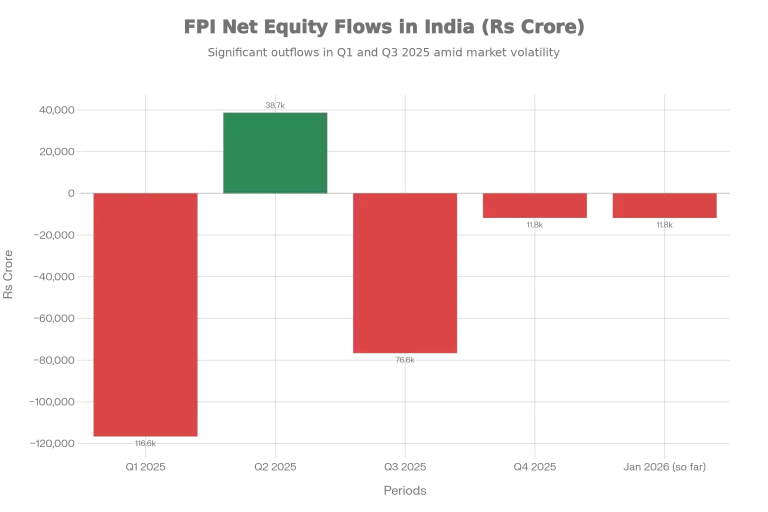
Period | Net Equity Flow (₹ Crore) |
|---|---|
Q1 2025 | -1,16,574 |
Q2 2025 | +38,673 |
Q3 2025 | -76,619 |
Q4 2025 | -11,766 |
Jan 2026 (so far) | -11,789 |
Market Impact and Domestic Response
This growing sell-off has exerted persistent pressure on key Indian indices. Recent sessions have seen volatility and weak breadth as foreign selling has continued over multiple trading days. However, domestic institutional investors (DIIs), mutual funds, and retail participants have stepped in to absorb some of this selling pressure, providing a degree of market stability.
Despite the outflows, the local market has avoided severe crashes, and quality stocks are occasionally seen as attractive buying opportunities by domestic long-term investors.
Will FIIs Return? What Comes Next
Experts believe that FIIs may return once certain uncertainties ease. Factors that could prompt renewed foreign interest include:
Improved clarity in global trade relations
Stabilisation of the Indian rupee
Global monetary policy clarity (especially on interest rates)
Strong corporate earnings and economic data
Historical patterns suggest that foreign outflows and inflows can be cyclical, influenced by global liquidity conditions and risk sentiment. As macro conditions evolve in 2026, market watchers will be closely monitoring these drivers for potential reversal or continuation of current trends.
Conclusion
The start of 2026 has seen FIIs emerging once again as net sellers of Indian equities, with over ₹11,700 crore exiting the market in January so far. A combination of trade uncertainty, geopolitical risk, currency pressures, and global rate ambiguity has contributed to this trend. While domestic investors have helped soften the impact, the sustained participation of FIIs remains a key factor for market momentum going forward.
Understanding these drivers can help investors interpret market volatility and position their portfolios with a balanced view of risk and opportunity.