How Iran Turned Weeks of US-Israeli Bombardment Into a Strategic Win
The US and Israel launched one of the most intense air campaigns in recent history. They killed Iran's Supreme Leader, destroyed its air defences, and called it a success. So why does Iran look stronger today than it did before the first bomb fell?
On February 28, 2026, the United States and Israel launched what they called "Operation Epic Fury." In a single 12-hour window, US and Israeli forces carried out nearly 900 strikes targeting Iranian missiles, air defences, military infrastructure, and leadership. The opening salvo killed Supreme Leader Ali Khamenei along with dozens of senior officials. By any conventional measure, this was supposed to be a knockout blow. A war designed to defang Iran's nuclear programme, destroy its military machine, and end decades of tension in one surgical campaign.
It did not go according to plan.
Weeks later, oil prices have surged past $100 a barrel, nearly touching $120 a barrel, the world's most critical shipping lane is paralyzed, Gulf Arab states are absorbing strikes they did not invite, and Iran's new leadership is digging in harder than ever. The country that was supposed to be broken is, in several important ways, more dangerous than it was before the war began. To understand how that happened, you need to start with what the US and Israel got badly wrong.
The Miscalculation That Changed Everything
The war's architects believed that removing Iran's top leadership would cause the system to collapse from within. They were wrong. The joint US-Israeli campaign evolved from initial strikes that killed Supreme Leader Ali Khamenei and dozens of senior military figures into sustained, large-scale air operations across Iran, with hundreds of strikes recorded in at least 26 of the country's 31 provinces and yet the Iranian state did not fracture.
The reason comes down to how Iran is actually built. As Middle East scholar Fawaz Gerges put it, the killing turned Khamenei from a contested ruler into a martyr. Rather than fracturing the system, the assassination unified it. The clerical establishment and the elite Revolutionary Guards closed ranks around a narrative of existential resistance, in which surrender became unthinkable and endurance sacred.
Iran appointed Mohammad Bagher Zolghadr, a former Islamic Revolutionary Guard Corps commander, as secretary of Iran's Supreme National Security Council following the strikes. His appointment signals that any Iranian negotiations will be more tightly aligned with the IRGC's threat perception and priorities, according to analysts. In other words, the people now running Iran's response are hardliners, not moderates. The war created exactly the kind of leadership it was trying to eliminate.
The attacks also followed the failure of indirect negotiations in February on a new agreement to curtail Iran's nuclear programme, with the Omani foreign minister having stated significant progress and Iran willing to make concessions. Still, President Trump said he was "not thrilled" with the talks. Diplomacy was within reach. The bombs ended it.
Iran's Real Weapon: The Strait of Hormuz
While the US focused on air superiority, Iran focused on something far more powerful: economic pain. Its primary weapon was not missiles or drones. It was a 34-kilometre-wide strip of water.
The Strait of Hormuz is roughly 50 kilometres wide at its entrance and narrows to about 33 kilometres at its tightest point. According to the US Energy Information Administration, about 20 million barrels of oil transited through the Strait of Hormuz each day in 2024, equating to nearly $500 billion in annual energy trade. Almost every barrel of oil exported from Saudi Arabia, Kuwait, Iraq, Qatar, and the UAE passes through this single chokepoint. Iran sits right on its northern shore.
On March 2, 2026, a senior official in the IRGC officially confirmed that the strait was closed, threatening any ship that passed through it. By that point, no tankers in the strait were broadcasting automatic identification system signals, indicating that traffic had effectively halted. As of March 12, Iran had made 21 confirmed attacks on merchant ships.
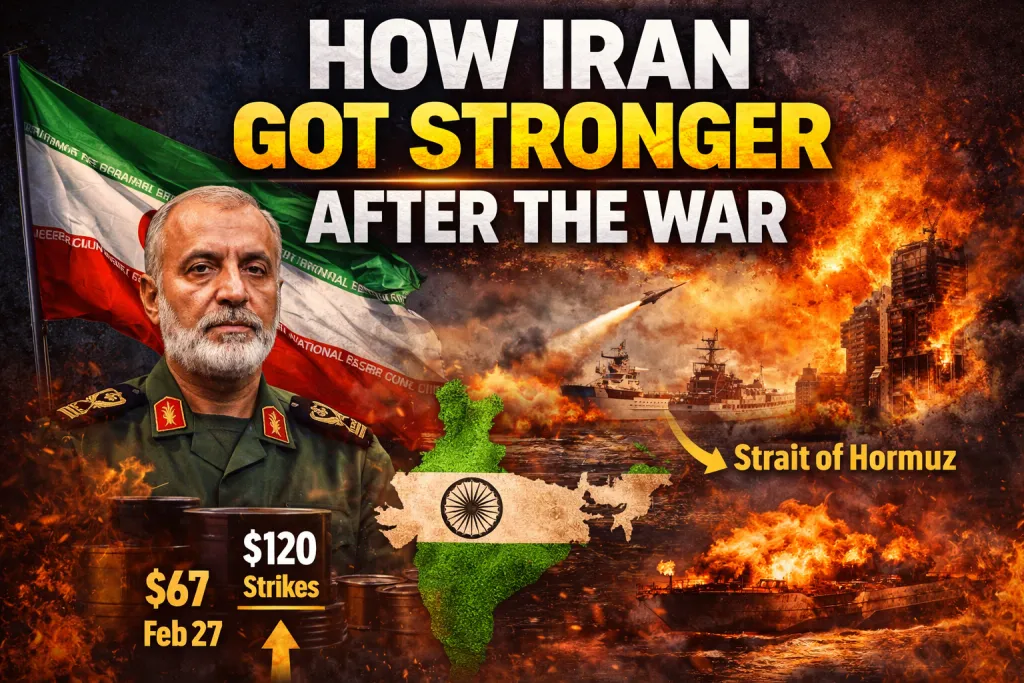
The economic consequences were immediate and staggering. Since the conflict began on February 28, the price of crude oil jumped above $100 per barrel on several occasions, up from around $67 before the first US-Israeli strikes. Oil hit as high as $98 per barrel, alarming consumers and markets worldwide. Oil prices surged from less than $70 a barrel on February 27 to a peak of nearly $120 early in the second week of the conflict. US gasoline prices crossed $4 per gallon, the first time since 2022.
The Dallas Federal Reserve estimated that a closure of the strait, removing close to 20 percent of global oil supplies, is expected to raise the average WTI oil price to $98 per barrel and lower global real GDP growth by an annualized 2.9 percentage points. That is not just an energy crisis. That is a structural shock to the global economy.
The World Pays the Price
Iran did not have to win a single aerial battle to achieve this. By simply threatening ships and closing the strait, it activated a chain of economic pain that spread far beyond the Middle East.
The 2026 Iran war, including the closure of the Strait of Hormuz, has led to what the International Energy Agency characterized as the "largest supply disruption in the history of the global oil market." The conflict echoed the 1970s energy crisis through acute supply shortages, currency volatility, inflation, and heightened risks of stagflation and recession. The oil production of Kuwait, Iraq, Saudi Arabia, and the UAE collectively dropped by a reported 6.7 million barrels per day by March 10, and by at least 10 million barrels per day by March 12.
Europe, which gets 12 to 14 percent of its LNG from Qatar through the strait, was hit hard. Dutch TTF gas benchmarks nearly doubled to over €60/MWh by mid-March. The European Central Bank postponed its planned interest rate reductions on March 19, raising its 2026 inflation forecast and cutting GDP growth projections, with economists warning that energy-intensive economies face high risks of technical recession if the maritime blockade persists. UK inflation is expected to breach 5% in 2026.
Even the food supply was disrupted. Up to 30 percent of world fertilizer exports, including urea, ammonia, phosphates, and sulphur, pass through the Strait of Hormuz. Disruption in the strait has already cut off fertilizer shipments, raising costs for farmers, and is likely pushing food prices higher. Nobel Prize-winning economist Simon Johnson of MIT said flatly: "The Strait of Hormuz has to be reopened. It's 20 million barrels of oil a day going through there, and there's no excess capacity anywhere in the world that can fill that gap."
Iran did not need to match the US militarily. It needed to impose costs. And it did.
The Gulf States: Collateral Damage in a War They Did Not Choose
Perhaps the most consequential unintended consequence of this war is what it has done to the Gulf Arab states, who have for years tried to maintain a careful balance with both Iran and the West.
Iranian strikes targeted US embassies and military installations in the UAE, Saudi Arabia, Qatar, Kuwait, Bahrain, Iraq, Oman, and Jordan. Countries that stayed out of the fight were drawn into it anyway. The war has caused a systemic collapse of the Gulf Cooperation Council economic model. The maritime blockade triggered a "grocery supply emergency" across GCC states, which rely on the Strait for over 80 percent of their caloric intake. By mid-March, 70 percent of the region's food imports were disrupted, forcing retailers to airlift staples, resulting in a 40 to 120 percent spike in consumer prices.
Mohammed Baharoon, director of Dubai's B'huth Research Center, summed it up clearly. The asymmetry lies at the heart of Gulf concerns: Iran could emerge from the war undefeated and with enhanced leverage, able to threaten shipping lanes, energy flows, and regional stability, while Gulf countries are left to shoulder the economic and strategic costs of an unresolved conflict.
Iran Still Firing, Still Standing
Despite the US claiming it has degraded 90 percent of Iran's missile capacity, Iran has continued to demonstrate its ability to strike with precision when it chooses to. After an attack on Iran's Natanz nuclear power plant, two Iranian ballistic missiles pierced through Israel's defence systems, hitting the southern cities of Arad and Dimona, wounding more than 180 people. Just last week, Iranian forces hit Qatar's main gas site, wiping out 17 percent of its export capacity, immediately after an Israeli attack on Iran's South Pars field.
By March 5, 2026, a military source told Iran's Fars News Agency that Iran had fired over 500 ballistic and naval missiles and almost 2,000 drones since February 28. For a country whose military was supposedly decimated, it has continued to project significant force.
Although US and Israeli military operations have successfully degraded 80 percent of Iranian air defences and struck critical industrial sites in Tehran and Isfahan, leading to widespread power outages, the Islamic Republic has remained resilient and capable of countering foreign threats. The Strait of Hormuz remains Iran's primary economic lever, with ongoing threats to the 20 million barrels of oil transiting daily.
What Happens If the US Walks Away Without a Deal
Trump has signalled he wants to end the war quickly, describing it as wrapping up "pretty quickly" while simultaneously threatening further escalation. The problem is that a premature exit without a security framework could leave the region in a more dangerous condition than before the war began.
Trump bombed Iran twice while his envoys were negotiating with Iranian representatives, in June 2025 and February 2026, and has repeatedly said that his goal is regime change. It is also unclear who in Iran would be in charge of any negotiations after US and Israeli attacks killed prominent members of the Iranian leadership. Trust has been destroyed. Diplomacy is being conducted through back channels via Egypt, Turkey, and Pakistan. Iran's new leaders are IRGC hardliners who are less inclined to compromise, not more.
Magnus Ranstorp, a terrorism expert, warned that Iran retains the capacity to activate long-standing global networks, using channels developed over decades to target Israeli, US, and allied interests far from the battlefield. "They haven't started yet, but they have a vast capability to punish the United States and Israel," he said, describing Iran as a threat whose reach extends well beyond the Middle East. If the US pulls back without a clear outcome, Tehran will not see it as a defeat. The theocratic system will have endured, the Strait will remain a threat, and Iran will be seen across the region as more dangerous than before the war.
The Bigger Picture: What Iran Has Actually Achieved
Strip away the destruction of its air defences and its proxies, and look at what Iran has actually accomplished since February 28. It survived the assassination of its Supreme Leader without collapsing. It installed a harder-line leadership that is less likely to make nuclear concessions. It closed the world's most important oil chokepoint and triggered a global energy crisis. It inflicted economic pain on Gulf states, Europe, and Asia without winning a single air battle. And it made the world's most powerful military think twice about the cost of continuing.
Iran did not need to win the war in the traditional sense. Its strategy, as described by the international security scholar Robert Pape, was one of horizontal escalation, widening the arena of conflict to extend the fight into the political and economic realms, to make the bombardment too costly to sustain. On that measure, it is working.
The war meant to break Iran may well end up leaving Tehran with a stranglehold over Middle East energy, a hardened political system, and a lesson for any future adversary: you do not need aircraft carriers to hold the global economy hostage. You just need to sit on the right waterway.