The Rise of India's Subscription Economy: A Structural Shift Worth Watching
The Quiet Revolution in How India Spends
Something fundamental has changed in how Indians spend their money. It is no longer about buying things — it is about accessing them, repeatedly, for a monthly fee.
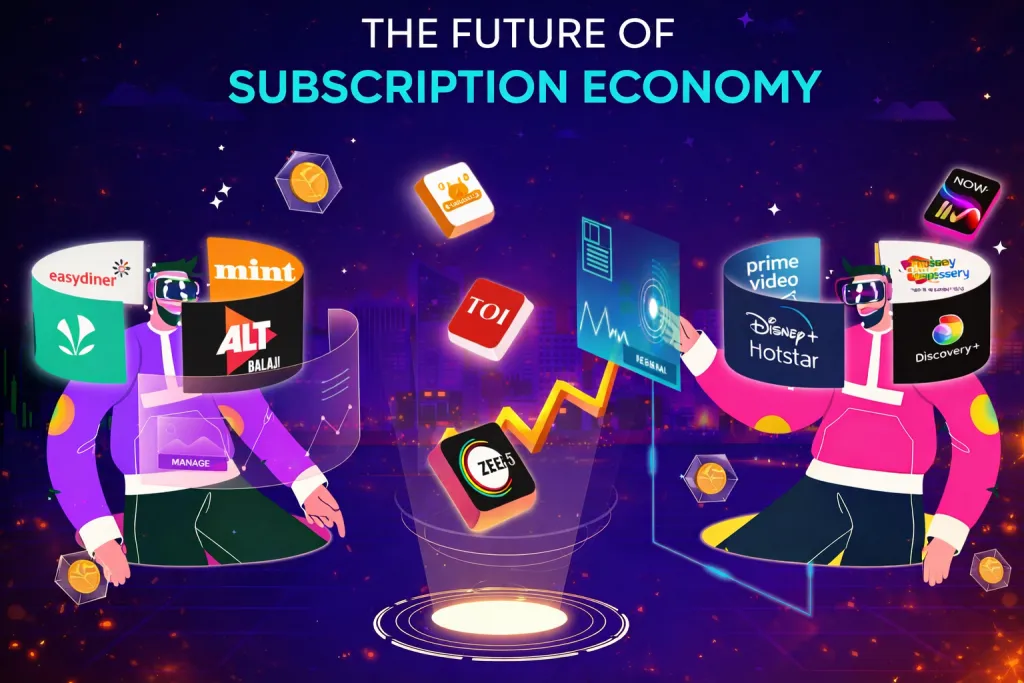
From the ₹149 Zomato Gold membership that makes your weekend delivery feel like a free treat, to the ₹349 PVR INOX Passport that gets you into four movies a month, to the ₹299 Swiggy One that bundles food delivery, Instamart, and Dineout into a single recurring deduction — India is embracing the subscription economy at a pace that is quietly becoming one of the most important investment themes of this decade.
This is not hype. The numbers back it up. And for investors who get ahead of this shift, the compounding opportunities are hiding in plain sight.
The Industry: Size, Scale, and Speed
Let us start with the macro picture, because it is genuinely staggering.
India's subscription e-commerce market was valued at USD 10.34 billion in 2024. By 2033, it is projected to reach USD 374.24 billion, a compound annual growth rate of 45.13%. That is one of the fastest-growing market trajectories across any consumer segment in any emerging economy.
The broader global subscription economy sat at roughly USD 492 billion in 2024 and is projected to cross USD 1.5 trillion by 2033. India, with its 800+ million internet users, 1.1 billion mobile connections, and a consuming middle class of roughly 120 million households, is positioned to capture a disproportionate share of that growth.
To put it in domestic terms: India's subscription market was approximately ₹1,200 crore in 2017-18. It is expected to reach ₹36,000 crore by 2025, a 30x expansion in under a decade.
What is driving this? Several structural forces are converging simultaneously.
Internet penetration has crossed 55% of the population, and 4G/5G infrastructure is rapidly closing the gap in Tier 2 and Tier 3 cities. The UPI ecosystem has made auto-debit and recurring payments frictionless in a way that was structurally impossible five years ago. India's demographic profile, where millennials and Gen Z account for 52% of the population, means the primary consumer cohort was raised on Netflix, Spotify, and app-store subscriptions. Recurring payments are not foreign to them. They are the default.
Then there is the content layer. India's OTT video audience hit 601.2 million users in 2025, growing at 10% year-on-year. Active paid OTT subscriptions stand at 148.2 million, up from 99.6 million in 2024. The India OTT market itself, valued at USD 3.9 billion in 2024, is projected to reach USD 19.25 billion by 2035 at a CAGR of 15.6%. The subscription model in media is no longer a novelty — it is the infrastructure.
Across verticals, the pattern repeats: food, fitness, beauty, edtech, fintech, and now even cinema. What was once a one-time transaction is becoming a recurring relationship. For companies that execute this correctly, it unlocks three things most businesses dream about: predictable revenue, higher customer lifetime value, and compounding data advantages that make the service better the longer someone stays subscribed.
The market is also maturing beyond its urban core. Tier 1 cities like Mumbai, Delhi, and Bengaluru still lead in adoption, but Tier 2 cities like Pune, Jaipur, and Lucknow are experiencing the steepest acceleration, driven by rising income levels and exploding smartphone and data penetration. The next 200 million subscription consumers in India will not come from South Delhi or Bandra — they will come from Indore, Coimbatore, and Surat.
The Direct Plays: Companies Selling Subscriptions to Consumers
Eternal (Formerly Zomato)
Zomato is the clearest consumer-facing subscription story among listed Indian companies, and it earns that label by doing something clever: embedding subscriptions into behavior that millions of Indians already have — ordering food.
Zomato Gold, the company's flagship membership programme, had 38 lakh (3.8 million) subscribers as of 2024. For ₹999 for six months or ₹1,800 annually, subscribers get complimentary dishes, delivery discounts, and dining-out benefits across partner restaurants. The pricing is designed to feel like a no-brainer for anyone who orders even twice a week — and that psychological anchoring is the point.
Subscription income currently contributes an estimated ~10% of Zomato's total revenue, with the company targeting 15-20% as Gold penetration deepens. But the financial contribution understates the strategic value. A Gold subscriber places significantly more orders — estimates suggest 40+ orders a year versus 8 for an occasional user — which means every subscription sold multiplies the transaction revenue behind it. It is a flywheel: subscribe → order more → generate more restaurant commission → fund better member benefits → reduce churn.
Zomato's recent aggression in growing Gold is notable. The company has used flash pricing (₹30 for six months on its anniversary) to dramatically expand the member base, betting on the belief that conversion to full-price renewal is a function of habit formation. In subscription economics, getting someone to day 30 is often more valuable than the price they paid to get there.
Beyond Gold, Blinkit (Zomato's quick commerce arm) is driving habitual, high-frequency usage that creates pseudo-subscription economics even without a formal membership — the kind of repeat, low-thought purchasing that creates platform lock-in.
Investor angle: As Gold subscribers grow, Zomato's unit economics improve structurally. Higher customer stickiness means lower effective customer acquisition costs. Better order frequency means better restaurant commission leverage. This is the compounding mechanism that long-term investors should be tracking.
Swiggy
Swiggy's listed journey is still young (it went public in late 2024), but its subscription strategy is increasingly sophisticated and worth watching as a direct competitor to Zomato's flywheel.
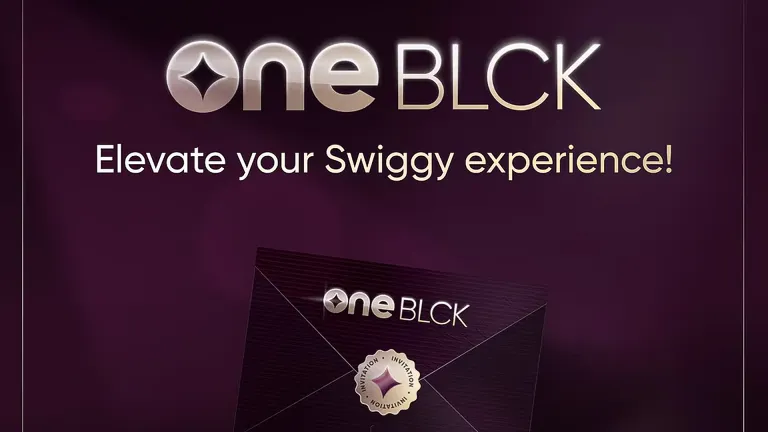
Swiggy One is the company's membership programme bundling free deliveries, Instamart discounts, and Dineout benefits into a single subscription. In December 2024, Swiggy went a step further, launching Swiggy One BLCK, an invite-only premium tier priced at ₹299 for three months, targeting high-frequency users who want a business-class experience across speed, reliability, and personalisation. Swiggy described it as the "business-class equivalent for customers," an explicit signal that they are building vertical subscription tiers, not just a flat membership.
Swiggy's total revenue reached USD 2.22 billion in the trailing twelve months as of early 2026, and the company is using the subscription layer as both a retention tool and a profitability accelerator — subscribed users are cheaper to serve per order because their behaviour is predictable and requires less promotional spending to keep engaged.
The competition between Swiggy and Zomato in the subscription layer is actually good for investors: it means both companies are pouring resources into making the membership product better, which raises switching costs and deepens the moat over time.
PVR INOX
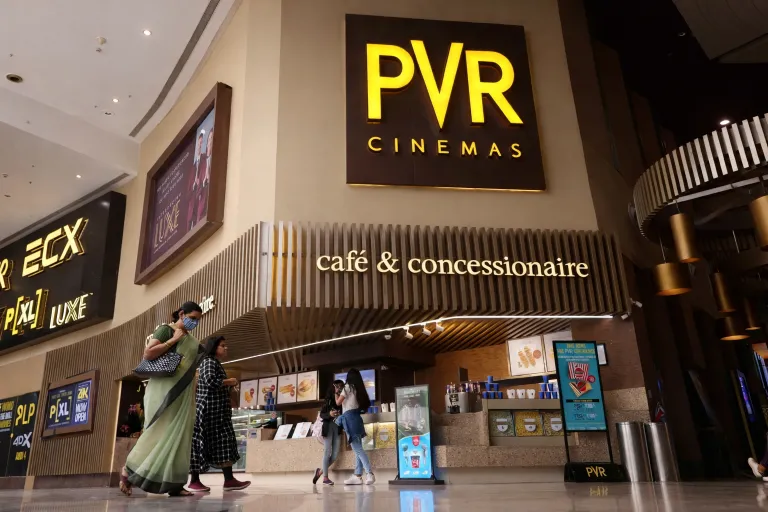
PVR INOX is perhaps the most conceptually interesting subscription play in this list, because it is attempting something genuinely novel: applying the Netflix mental model to the experience of going to a movie theatre.
The company launched PVR INOX Passport in October 2023, India's first theatrical subscription service, initially priced at ₹699 per month for up to 10 films (weekdays only), bringing the per-visit cost to just ₹70. In March 2024, it launched Passport 2.0 at a revised price of ₹349 per month for four films, making the offering more accessible and less operationally risky.
The logic Gautam Dutta, co-CEO, articulated at launch is worth remembering: "Time-rich and cash-poor are my target audience." Students, housewives, retired professionals, and people who love cinema but feel the ₹250-400 per-ticket barrier every time they consider going. The Passport removes that friction and converts irregular visitors into habitual moviegoers.
This matters for PVR INOX's financial structure in a significant way. India's multiplex business has always been deeply cyclical — blockbuster weekends followed by weeks of thin content. A subscription base creates a floor of predictable revenue that cushions the business during content droughts. It also creates a data advantage: the company can now see exactly who its most engaged customers are and target them with offers, loyalty benefits, and upsells to premium experiences like IMAX and Gold Class (which are excluded from the Passport, protecting the premium margin).
The deeper play is on the mid-tier film market. Big event films — Pathaan, Jawan, Stree 2 — will always fill seats. The problem is the film between blockbusters, the Rs 80 crore Bollywood thriller that struggles to find an audience. Passport holders, because they have already paid, have a far lower mental barrier to try a less-hyped film on a Tuesday afternoon. PVR INOX is essentially trying to create the same "scroll and discover" behaviour that made Netflix indispensable, except for the physical cinema.
The Background Players: Who Builds the Engine Room
Consumer-facing subscriptions grab the headlines, but the structural investment opportunity in India's subscription economy extends to the companies quietly powering the infrastructure beneath it. These are picks-and-shovels plays — and in many cases, cleaner business models.
Tanla Platforms is perhaps the most underappreciated enabler. India's largest CPaaS (Communications Platform as a Service) provider, Tanla processes over 800 billion interactions annually and handles approximately 63% of India's A2P SMS traffic. In plain terms: every time Zomato texts you "Your Gold membership is expiring," every OTP login for a subscription app, every renewal reminder from Swiggy One — that communication infrastructure is dominated by companies like Tanla. The company posted revenue of ₹4,070 crore in FY2025, growing steadily, with EBITDA margins around 17-18%. It holds a 35% market share in India's CPaaS space — an oligopoly position in critical digital infrastructure that has no meaningful physical equivalent.
Affle India (NSE: AFFLE) plays a different but equally important role: customer acquisition and retention for subscription businesses. Subscription models are only as good as their ability to acquire users cheaply and retain them long enough for LTV to exceed CAC. Affle's data-driven platform helps apps and platforms do exactly that — targeting the right user, at the right moment, on the right device. Its platform model means clients pay regularly, making Affle itself a subscription-like business. In an economy where every D2C brand, fintech app, and OTT platform is spending aggressively to grow their subscriber base, Affle sits at a structural chokepoint.
RateGain Travel Technologies completes the picture for the hospitality and travel side of the subscription economy, loyalty programmes, dynamic pricing, and customer data analytics for hotels and airlines. As India's travel economy re-accelerates post-pandemic and loyalty programmes become central to airline and hotel strategy, RateGain's SaaS revenue base (built on recurring enterprise contracts) represents a clean B2B subscription model with strong underlying demand.
The Bigger Picture: Why This Is Not Just a Theme
India's subscription economy is not a trend — it is a structural rewiring of how value is exchanged between businesses and consumers. The shift is powered by infrastructure (UPI, 5G, smartphone penetration), demographics (a young, digitally-native consuming class), and psychology (convenience now outweighs ownership for a rapidly growing segment of the population).
For investors, the most important insight is this: India does not yet have a pure-play listed subscription company like Netflix or Spotify. What it has are hybrid businesses — Zomato, Swiggy, PVR INOX — that are embedding subscription layers into larger ecosystems. And behind them, a set of infrastructure companies — Tanla, Affle, RateGain — whose recurring revenue grows every time the consumer subscription economy grows.
The pure-play opportunity will come. As Indian SaaS businesses mature and IPO pipelines develop, listed access to companies like Chargebee (subscription billing infrastructure) or Capillary (loyalty and CRM) will open up. But right now, the smart money watches the hybrids and the enablers — because that is where the compounding is already happening.
The subscription economy in India is not a distant thesis. It is in your pocket. It is the ₹149 deducted from your account every month before you even notice. And that frictionless, invisible, recurring deduction is exactly what makes it so valuable.