Ola Electric Stock Analysis: What Triggered the 50% Rally in just Seven Trading Sessions?
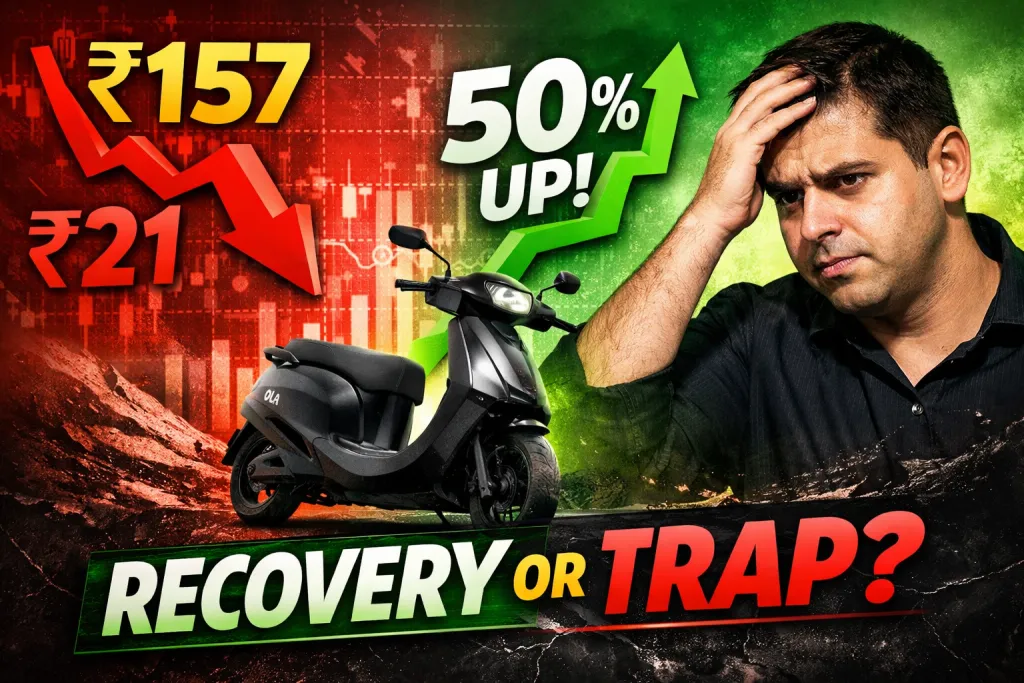
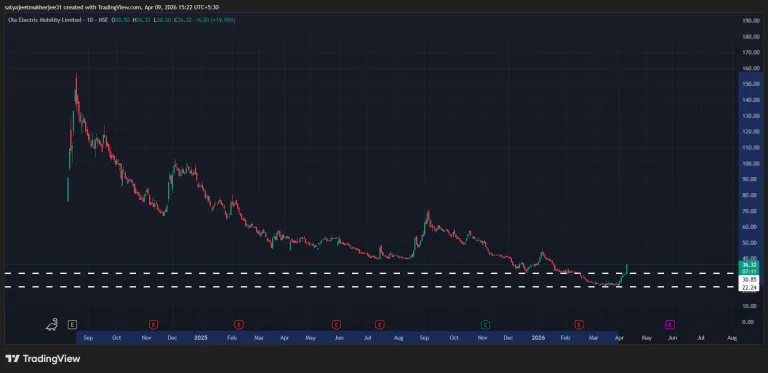
Over the past 18 months, Ola Electric’s stock has gone through a dramatic and volatile journey, falling sharply from ₹157 to ₹21 before staging a sudden rebound of nearly 50% within just seven trading sessions. Such extreme price movements are rare, even in high-growth sectors like electric vehicles, and they naturally raise an important question: Are we witnessing the early signs of a turnaround, or just a temporary bounce driven by sentiment?
The answer is not straightforward. Depending on the lens you use, this could either be the beginning of a recovery story in India’s EV space or a classic dead-cat bounce fueled by short-term optimism and positive news flow. What makes this case particularly interesting is that both sides of the argument are backed by real, company-specific developments. To understand what is truly happening, it is essential to break down the reasons behind both the steep decline and the recent rally, layer by layer.
Part 1: The Fall — How India's EV Pioneer Lost Its Way
Ola Electric Mobility listed on Indian exchanges in August 2024 at a valuation of approximately $4 billion, raising around $734 million in India's first pure-play EV IPO. The stock debuted with 20% gains and rode the euphoria of being at the forefront of India's electric mobility revolution. The company had, at one point, commanded a staggering 35% market share in India's electric two-wheeler segment — nearly half the market.
By March 2026, the stock had hit a 52-week low of ₹21.21. Down 80%+ from its peak. Here is exactly what went wrong.
1. The Service Catastrophe
If there is one root cause of Ola's downfall, it is this: the company sold far more scooters than its service infrastructure could handle, and it paid a brutal price.
Customer complaints surged to approximately 80,000 per month, with users reporting long service delays, repeated breakdowns, and warranty mishaps — including cases where the warranty started before actual delivery. Physical assessments at service centres painted a grim picture: overwhelmed facilities, vehicles left unattended for weeks, cramped parking yards, and a workforce unable to match the pace at which Ola had scaled its sales.
The government wasn't going to ignore this. India's consumer rights enforcement agency sent Ola a warning letter, seeking a legal explanation for the 10,664 consumer complaints it had received. Things escalated to the point where a consumer court in Goa issued a bailable arrest warrant for founder Bhavish Aggarwal after he ignored a summons in a case where a customer's scooter stopped working and was never returned after servicing. The Bombay High Court granted a stay, but the reputational damage was done.
2. The Market Share Bloodbath
The service failures translated directly into customers walking away — and straight into the arms of legacy players. Ola Electric's market share had fallen sharply, from over 35% in 2024 to under 6% by January 2026, allowing competitors like TVS Motor (24.2%), Bajaj Auto (21.9%), and Ather Energy (16.2%) to surge ahead.
Ola's first-mover advantage had effectively evaporated. "Ola's early competitive advantage as a first mover has diminished as established two-wheeler manufacturers have entered the electric vehicle space," said D Dhanuraj of the Centre for Public Policy Research. "Brand trustworthiness and loyalty are now challenged by these older, established players."
The sales numbers tell the story bluntly: only 8,647 Ola scooters were registered in February 2025, down from nearly 34,000 a year ago. By February 2026, registrations had fallen to just 3,973 units — a collapse of over 75% year-on-year.
3. Financial Bleeding and Promoter Exits
The operational chaos showed up directly in the financials. Revenue declined 43.16% from ₹1,214 crore in Q2 FY25 to ₹690 crore in Q2 FY26, while net losses narrowed only marginally. In Q3 FY26, Ola Electric reported a net loss of ₹487 crore alongside a 55% year-over-year revenue decline, with operating cash flow staying negative.
To make matters worse for investor sentiment, SoftBank Group reduced its holding from 15.6% to 13.5% in what appeared to be a staggered exit, and founder Bhavish Aggarwal himself sold chunks of his personal shareholding through open market transactions on multiple occasions, moves that spooked retail investors and accelerated the selloff.
4. A Company Stretched Too Thin
Ola repeatedly missed timelines for its gigafactory, battery commercialisation, and new vehicles, signalling operational overstretch and raising doubts about its long-term strategy. The product chaos didn't help either; the company quietly discontinued its affordable Ola Gig and S1 Z scooter range less than a year after launching them. In the last quarter of 2024 alone, a slew of executives left the company, including the CTO, CMO, CPO, CBO, and head of sales, and the CEO had resigned just three months into his tenure earlier that year.
By early 2026, Ola Electric ranked 5th in the EV two-wheeler market, a company that was once the undisputed #1.
Part 2: The Rally — What Changed in 7 Trading Sessions
So why is the stock up 50%? Three things hit in rapid succession in the first week of April 2026, and the market responded.
Trigger 1: The March Sales Numbers
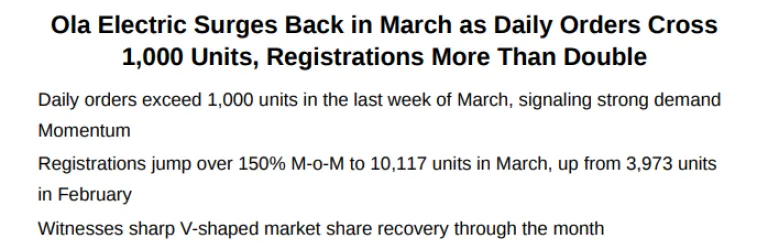
The most immediate trigger was the business update for March 2026. Ola Electric reported a sharp recovery in demand, with daily orders crossing 1,000 units in the last week of March 2026 and total registrations reaching 10,117 units, up from 3,973 units in February, marking over 150% month-on-month growth.
The company also crossed a symbolic milestone: Ola Electric became the first EV company in India to cross 1 million cumulative registrations as per VAHAN data. Sunny Agrawal, head of fundamental research at SBI Securities, noted that improvements in after-sales service quality, extended warranty, buyback guarantee, and other benefits appeared to have improved customer sentiment.
One important nuance worth flagging: towards the end of March, Ola Electric launched a campaign offering discounts of up to ₹50,000 across its portfolio, with some variants priced as low as ₹49,999, running from March 26 to March 31. This means a portion of the March spike was end-of-month, heavily discounted volumes, not purely organic recovery. Investors should keep that context in mind when reading the "V-shaped recovery" narrative.
Trigger 2: The Roadster X+ Gets a ₹60,000 Price Cut
On April 2, 2026, Ola dropped a bombshell on pricing. Ola Electric announced a price reduction of ₹60,000 on its flagship electric motorcycle, the Roadster X+ 9.1 kWh powered by its 4680 Bharat Cell, from ₹1,89,999 down to ₹1,29,999, attributing the move to rapid economies of scale at its Gigafactory and deep vertical integration of its indigenously developed 4680 Bharat Cell.
To understand why this matters, you need to understand what the 4680 Bharat Cell is.
What is the 4680 Bharat Cell? It is India's first indigenously designed, engineered, and manufactured large-format lithium-ion cell — built at Ola's Gigafactory in Krishnagiri, Tamil Nadu. The cell is engineered to provide higher energy density, superior thermal management, and an extended vehicle range. The cylindrical form factor and advanced dry electrode technology represent a leap over older battery technologies. For context: this is the same cell format Tesla uses in its 4680 cells, but Ola's version is Made in India, with all R&D done domestically.
The significance is structural, not cosmetic. When a company builds its own cells in-house, it controls the single highest-cost component in an EV — the battery. As production scales, costs fall. As cell production ramped up, cost efficiencies improved materially, allowing Ola Electric to pass on these benefits directly to customers. The company is scaling Gigafactory capacity toward 6 GWh, and every GWh of additional capacity means lower per-unit battery costs.
The Roadster is also Ola's entry into India's electric motorcycle segment — a far larger addressable market than electric scooters. Demand for the Roadster X+ had surged more than 5X during the company's #EndICEAge campaign, exceeding current supply capacity. A ₹60,000 price cut on a motorcycle with 500 km range, now priced at ₹1.29 lakh, places it within reach of a far wider buyer base.
The Shakti Cell — Another Revenue Leg Emerging
While everyone focused on the scooter business, Ola quietly launched another product powered by the same Bharat Cell: Ola Shakti, India's first residential battery energy storage system (BESS). Rolled out from the Gigafactory in Krishnagiri, Shakti marks the company's entry into India's residential BESS market, taking Ola beyond the automotive domain entirely. Available in four configurations from 1.5 kWh to 9.1 kWh, it is essentially a home inverter and battery system that can power ACs, refrigerators, and farm pumps — at automotive-grade safety and with instant 0 ms changeover time.
This matters for a very simple reason: Ola's Gigafactory and cell technology now serve multiple revenue streams: two-wheelers, motorcycles, and residential energy storage. Each product that uses the Bharat Cell justifies more Gigafactory scale, which drives down cell costs across all products. This is a genuine compounding dynamic, not just a pivot narrative.
Trigger 3: PLI Certification for the Roadster
On April 3, 2026, just one day after the price cut announcement, came another catalyst. Ola Electric received Certification for Compliance with the eligibility requirements under the Production Linked Incentive (PLI) Scheme for its Roadster X+ 4.5 kWh from the Global Automotive Research Centre, making it the first motorcycle in the Roadster portfolio to receive PLI certification.
For those unfamiliar, the PLI-Auto Scheme is a government programme that rewards manufacturers for domestic production growth by providing financial incentives linked to incremental sales. In Ola's case, the company is the only automaker in India to benefit from two PLI schemes — the Champion OEM incentive under the Automobile PLI and the Cell PLI schemes.
The PLI certification on the Roadster does two things simultaneously: it makes each unit sold more financially rewarding for Ola (reducing effective cost), and it validates the domestic value addition in the product, which in turn supports further price reductions for customers. Lower prices → more demand → higher PLI incentives → even lower prices. It is a policy-backed flywheel.
The Hyperservice Turnaround
Underpinning all of this is something that often gets lost in the headline numbers: Ola's genuine operational overhaul of its service infrastructure. Ola Electric stated that over 80% of vehicles are now serviced on the same day, supported by enhanced parts availability, faster diagnostics, and tighter operational control across its network. The company launched dedicated Hyperservice Centres starting in Bengaluru, offering digital tracking from check-in to delivery with no additional charge.
If this holds — and it is a big if — it addresses the single biggest reason customers were abandoning the brand. Service was the wound. Hyperservice is either the stitching or just a bandage. The next two quarters will tell us which.
Bottom Line
Here is the honest take.
The positives are real: March sales up 150% MoM, Roadster demand grew 5X, ₹60,000 price cut enabled by genuine in-house cell cost improvements, PLI certification for the motorcycle lineup, and the Bharat Cell platform creating a second revenue stream through Shakti. These are not manufactured catalysts — they are structural moves.
But the risks are equally real. Analysts at Emkay Global noted that Ola has seen a consistent volume decline to 32,000 units in Q3 (down from 125,000 in Q1), and the company has turned net-debt from net-cash, now at ₹670 crore in debt as of 9M FY26. A single month of improved registrations does not address these underlying financial challenges, and the primary risk going forward is margin erosion, as slashing prices aggressively could deepen net losses if volumes don't scale fast enough to cover fixed costs.
The stock rallied from ₹21 to approximately ₹34 in 7 sessions. That is a bounce from deeply oversold territory on specific positive triggers, not a fundamental rerating. The stock is still down over 70% from its all-time high.
For investors, the question is not whether Ola has bounced. It has. The question is whether the 4680 Bharat Cell ecosystem, the PLI tailwinds, the Roadster motorcycle play, and the Hyperservice operational reset can rebuild the business sustainably over the next 4–6 quarters, at a time when TVS, Bajaj, and Ather are all executing well.
Ola Electric is not dead. But it is not recovered either. It is in the middle of a comeback story that is still being written, by a company with genuine technology assets and genuinely serious execution problems. Watch the Q4 FY26 numbers closely. The truth is in the data, not the press releases.
Disclaimer: This article is for informational purposes only and does not constitute investment advice. Please conduct your own due diligence before making any investment decisions.