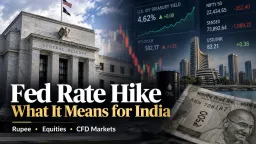
Fed Raises Rates for First Time in Three Years: What It Means for India
Fed Raises Rates for First Time in Three Years: What It Means for India
Time to read: 3 minutes
The US Federal Reserve raised interest rates by 25 basis points on September 16, taking its benchmark rate to 3.75%–4.00% in its first hike in more than three years.
For India, attention is now turning to the rupee, crude oil prices, foreign investment flows and the potential impact on inflation.
The Federal Open Market Committee voted unanimously for the increase, saying US economic activity continues to expand at a solid pace while inflation remains elevated. The Fed's latest projections put PCE inflation at 3.7% in 2026 and core PCE inflation at 3.4%, both above its 2% target.
Its projections also indicate that interest rates could remain higher in the months ahead.
Rupee Faces Pressure From a Stronger Dollar
The rupee closed at ₹95.9550 against the US dollar on September 16, before the Fed announced its decision at 11:30 p.m. IST.
Following the rate hike, the dollar strengthened against major currencies, putting further pressure on several Asian currencies. Traders are now closely watching whether the rupee moves beyond the ₹96-per-dollar level.
Higher US interest rates can make dollar-denominated assets more attractive to global investors. This can strengthen demand for the dollar and put pressure on emerging-market currencies such as the rupee.
For Indians, a weaker rupee can make overseas education, international travel and dollar-priced imports more expensive. Indian companies dependent on imported raw materials may also face higher costs.
Oil Above $100 Adds to India's Import Costs
Currency pressure comes at a time when global crude oil prices are already elevated.
Brent crude was trading around $105–106 per barrel during Asian trading on September 17, although prices eased slightly as concerns over immediate supply disruptions moderated.
India imports around 85% of the crude oil it consumes, making the country sensitive to both oil prices and movements in the rupee.
When crude prices are high and the rupee weakens, Indian refiners need more rupees to pay for dollar-denominated oil imports. Higher energy costs can then affect transportation, aviation, shipping, chemicals and other industries.
Retail petrol and diesel prices are also influenced by taxes and domestic pricing decisions, so higher crude does not automatically translate into an immediate increase at the pump. However, sustained high oil prices can add to broader inflationary pressure.
Indian Shares Edge Higher Despite Fed Hike
Indian equities showed a relatively measured reaction on September 17.
During morning trading, the Nifty 50 was up around 0.26% at 23,279, while the Sensex gained around 0.16% to 74,453.
The gains came despite pressure from higher US rates and elevated crude oil prices, with most major Indian sectors trading higher.
However, the Fed's decision remains relevant for Indian markets because higher US bond yields can influence where international investors allocate their capital.
The impact also differs across sectors. Companies dependent on imported materials may face higher costs, while IT companies are affected by both rupee movements and demand conditions in major markets such as the United States.
Will Your Home Loan EMI Increase?
Not directly.
The Federal Reserve does not determine Indian home loan, car loan or personal loan rates.
Indian borrowing costs are primarily influenced by the Reserve Bank of India, domestic liquidity conditions and individual bank lending policies. The RBI's policy repo rate currently stands at 5.25%.
However, developments in the US can indirectly matter.
If a weaker rupee and higher crude oil prices contribute to higher inflation in India, they may become factors the RBI considers when setting future monetary policy. India's retail inflation rose to 4.82% in August, adding to the focus on domestic price pressures.
Any change in Indian EMIs would therefore depend on RBI policy and domestic banking conditions rather than automatically following the Fed's rate hike.
What Should Indians Watch Next?
The immediate focus will be on three areas: the rupee, crude oil and the RBI.
Further weakness in the rupee could raise the cost of imports, while sustained crude prices above $100 per barrel could add to India's energy bill. Investors will also watch upcoming RBI communication for its assessment of inflation, liquidity and external conditions.
In the US, inflation and employment data will help determine the Federal Reserve's next move.
For India, the Fed hike does not change borrowing costs or consumer prices overnight. But through the dollar, oil prices and global capital flows, its effects can gradually reach Indian households, businesses and financial markets.
Disclaimer: This article is for educational and informational purposes only and does not constitute investment, trading or financial advice. Market prices, interest rates and exchange rates can change rapidly.