Top Futures Trading Strategies That Actually Work: From Hedging to Momentum Plays
Futures trading offers opportunities not only for speculation but also for risk management and capital efficiency. While markets evolve, core futures strategies have remained effective across cycles when used with discipline.
This guide covers the most widely used, time-tested strategies in the futures market, along with practical examples referencing Indian indices, commodities, and major currency pairs.
1 Trend Following Strategy
“The trend is your friend, until it bends.”
This strategy aims to trade in the same direction as the prevailing trend, often using:
Moving Averages (20/50/200 SMA)
ADX for trend strength
Price structure (Higher highs / Lower lows)
Setups:
→ Buy Nifty futures above a breakout of previous swing high
→ Sell crude oil futures when price breaks key support with increasing volume
Example:
If Nifty 50 steadily trades above the 50-Day SMA with strong ADX → Bulls are in control → Long positions favored.
Where it fails:
Range-bound or highly volatile markets.
2 Breakout Trading Strategy
Used when price escapes consolidation and begins a new directional move.
Indicators:
Support & Resistance levels
Chart patterns (Triangles, Flags)
Volume expansion confirmation
Example:
Gold futures breaking above a multi-week resistance with high volume → long entry.
Stop-loss just below the breakout zone.
Key rule: Avoid early entries before confirmation.
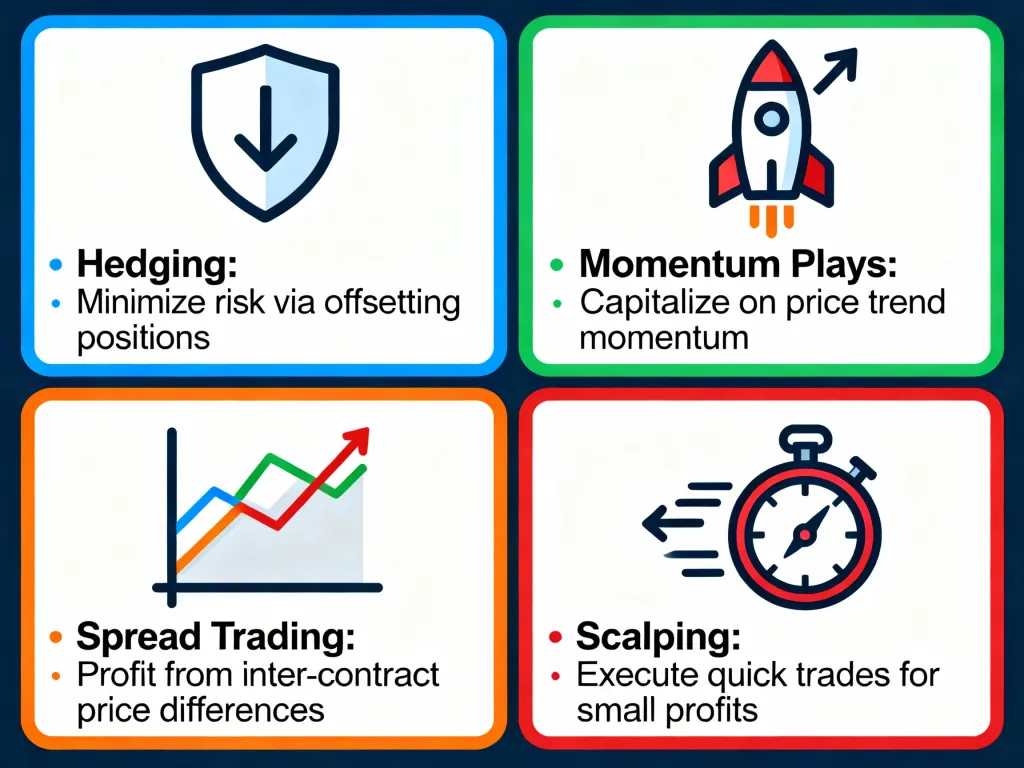
3 Spread Trading Strategy (Advanced but powerful)
Reduces directional risk by trading the price difference between two related futures contracts.
Types:
Spread Type | Example | Objective |
|---|---|---|
Calendar Spread | Buy Near, Sell Far month on Nifty | Profit from cost of carry shifts |
Inter-Commodity | Crude Oil vs Natural Gas | Relative performance trade |
Index vs Sector | Bank Nifty vs Nifty | Capture sector outperform/underperform |
Pros:
Lower margin requirement
Reduced volatility risk
Often used by professional traders and institutions
4 Hedging Strategy
Used by businesses, institutions, and sometimes traders to protect against price risk.
Examples in India:
A jeweler hedges gold price risk with Gold MCX Futures
Exporters hedge USD/INR fluctuations using currency futures
Equity investors hedge a portfolio by shorting Nifty futures
Goal: Stabilize returns, not maximize profits.
5 Momentum Strategy
Momentum traders capitalize on strength becoming stronger over the short term.
Tools:
RSI above 60 (bullish momentum)
MACD crossovers
High relative volume
Example:
If Bank Nifty shows sharp relative strength vs Nifty + bullish candle patterns → Long Bank Nifty futures for short-term momentum.
Risk: Momentum can reverse rapidly - tight stop-loss essential.
6 Mean Reversion Strategy
Markets often return to the average, especially in range-bound phases.
Indicators:
Bollinger Bands
RSI oversold/overbought markers
Example:
If silver futures hit the lower Bollinger Band with bullish reversal candle → Long targeting mid-band.
Works best in sideways markets - avoid during strong trends.
Bonus: News & Event-Driven Strategy
Used around:
RBI policy announcements
U.S. Fed decisions
Crude oil inventory data
GDP & inflation releases
Election results
📌 Tip: Let volatility settle before entering trades.
Market reactions can be irrational immediately post-event.
Position Sizing & Risk Management: The Success Backbone
Regardless of strategy:
→ Keep risk per trade 1–2% of capital
→ Always use stop-loss orders
→ Reduce leverage during high volatility
→ Avoid over-trading and revenge trades
As professionals say:
“In futures trading, defense wins championships.”
Which Strategy Fits You?
Strategy Type | Best For | Market Condition |
|---|---|---|
Trend Following | Medium–long term traders | Trending markets |
Breakouts | Aggressive traders | Start of new trends |
Spreads | Pros, hedgers | Volatile or correlated markets |
Hedging | Investors & businesses | Always |
Momentum | Intraday / Swing traders | Strong volume moves |
Mean Reversion | Range traders | Sideways markets |
Pick a strategy that matches your psychology, not someone else’s.
Final Thoughts
Futures trading rewards discipline over excitement.
The best traders consistently apply simple strategies with:
Proper risk controls
Correct position sizing
Emotion-free execution
Hedging, trend following, momentum trading, breakouts, spreads, and mean reversion continue to be reliable frameworks, as long as traders respect risk first.
As the saying goes:
Strategies don’t make traders profitable.
Risk management does.
**This article is for educational and informational purposes only and does not constitute investment advice or a recommendation. Futures trading involves a high level of risk. Readers should consult with a SEBI-registered financial advisor before making investment decisions.