When the Safe Haven Broke Down: Why Gold, Silver, and Equities All Crashed During the Iran-US War
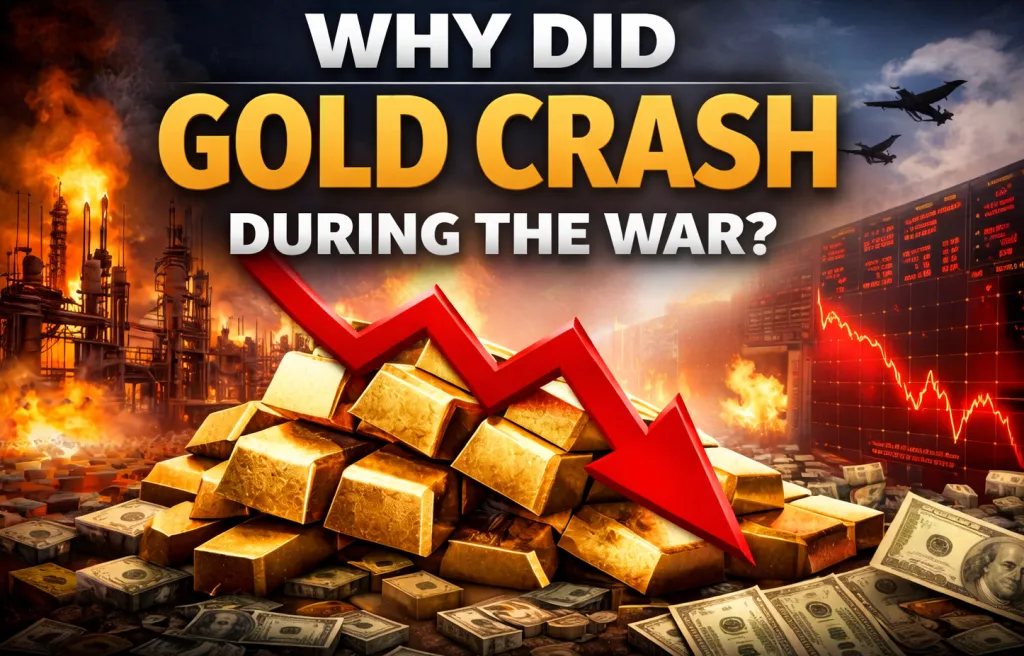
There's a rule every investor learns early in their financial education. When fear grips the market — when war breaks out, when economies wobble, when equities fall off a cliff, you run to gold. The yellow metal has been the world's oldest security blanket for centuries. It doesn't yield dividends. It doesn't report quarterly earnings. But when everything else burns, gold is supposed to hold.
March 2026 tore that rulebook apart.
The Scene: A War Nobody Priced In Correctly
On February 28, 2026, US-Israeli airstrikes on Iran triggered the most significant Middle East conflict in decades. If ever there was a moment that should have sent gold soaring and kept it there, this was it. Geopolitical chaos. Energy supply disruption. Global uncertainty at scale.
Instead, what unfolded over the next 30 days was nothing short of extraordinary — and deeply confusing for millions of retail investors watching their portfolios bleed.
Gold, which had scaled a stunning all-time high of $5,602 per ounce in January 2026, crashed nearly 25% to a low of $4,100 by mid-March. At the same time, equities across Asia and Europe tumbled, Japan's Nikkei fell over 13% in March alone, and the EuroStoxx 600 erased virtually all of its year-to-date gains.
Back home in India, the pain was equally sharp. MCX Gold, which had touched a record ₹1,80,779 per 10 grams in late January, nosedived to around ₹1,31,000–₹1,38,000 levels by mid-to-late March — a fall of over ₹58,000 per 10 grams in less than 60 days. On a single day, March 23 alone, MCX gold collapsed over 8% in intraday trade, at one point touching ₹1,31,508 per 10 grams. Silver's story was even grimmer: MCX Silver, which had briefly touched ₹4,20,048 per kilogram in January, was trading near ₹2,00,000–₹2,13,000 by late March — a fall of more than 50% from its peak.
Gold was poised for its worst month in more than 17 years. And it had nothing to do with the war itself. This wasn't a small correction, but rather, this was a structural, macro-driven collapse — and understanding why it happened is one of the most important market lessons of this decade.
Also Read: https://www.investwhat.in/india/investment/equities/26655/rentomojo-ipo-under-legal-scrutiny
Act 1: Gold Was Already Flying Before the War
To understand why gold crashed so hard, you first need to understand just how high it had already flown.
In 2025, gold delivered one of its best annual performances in living memory — rising over 60% as central banks globally went on a buying spree, accumulating over 1,000 tonnes for the third consecutive year. ETF inflows were surging. Fears about the US dollar's reserve status, geopolitical tensions, and inflation hedging made gold the most loved asset in every portfolio manager's deck.
By January 2026, gold was already up a staggering 66% year-to-date before the war even started. Silver had done even better — it surged 147% in 2025, briefly crossing $121.67 per ounce, its best level since 2013. On MCX, gold had already run from roughly ₹78,000 per 10 grams at the start of 2024 to nearly ₹2 lakh by January 2026. Comex gold had rallied from $3,307 to $5,247 per troy ounce in just 7 months — a 59% surge in less than a year.
Gold rose 23.9% over the 30 days before the US-Israeli airstrikes — second only to the Soviet invasion of Afghanistan in December 1979, when gold surged 25.6% in the preceding month.
When any asset runs up that sharply that fast, it creates a dangerous condition the market calls a "crowded trade." Everyone who wanted to own gold already owned it. And everyone who owned it was sitting on enormous profits. The moment fear entered the market — not just geopolitical fear, but the far more dangerous fear of inflation and tightening monetary policy — those holders didn't buy more gold. They sold.
Act 2: Oil Was the Villain, Not the War Itself
Here is where the story gets more interesting. Wars in the Middle East have historically pushed oil prices up. And normally, rising oil is inflationary — and gold, as an inflation hedge, rises too.
But 2026 broke that linkage, and the reason is the sheer magnitude of the oil shock.
Brent crude surged past $120 per barrel following the closure of the Strait of Hormuz on March 4, and was 55% higher on the month in the last week of March. The International Energy Agency called it "the largest supply disruption in the history of the global oil market." The collective oil production of Kuwait, Iraq, Saudi Arabia, and the UAE dropped by a reported 6.7 million barrels per day by March 10 — and by at least 10 million barrels per day by March 12.
This wasn't a modest price bump. It was a supply shock so severe that it triggered the biggest-ever release of 400 million barrels from strategic reserves globally.
When oil spikes this aggressively, it does something nasty to gold: it destroys the very macro conditions that make gold attractive. Here's the chain reaction that played out in real time:
Oil surges → Inflation spikes → Fed can't cut rates → Bond yields rise → Gold becomes less attractive than yield-bearing assets
Markets shifted expectations from two anticipated Fed rate cuts in 2026 to a possible rate hike in a matter of weeks. That is a seismic pivot. And for gold, a non-yielding asset, it was the equivalent of pulling the oxygen out of the room.
Act 3: The Fed Held Its Ground — and That Hurt Gold
Gold is fundamentally a bet against real interest rates. When rates are low or falling, gold thrives because the "opportunity cost" of holding a non-yielding metal is low. When rates rise or stay high, every rupee or dollar in gold has to justify itself against safer, income-generating alternatives like Treasury bonds or Fixed Deposits.
The US Federal Reserve held rates at 4.75%–5.00% through at least June 2026, per March FOMC guidance. The European Central Bank, which had planned rate reductions, postponed them on March 19 — raising its 2026 inflation forecast and cutting GDP growth projections instead.
Tim Waterer, chief market analyst at KCM Trade, put it clearly: with oil hovering around $100–$120 and inflation expectations climbing, higher rate expectations have "tarnished gold's appeal from a yield point of view." The math was simple and brutal — why hold a metal that earns nothing when bonds are offering real returns?
Act 4: The US Dollar Took Gold's Throne
This is the chapter that gets left out of most market analyses. And it's arguably the most important one.
Most retail investors think of gold and the US dollar as separate things. They're not. They are, in many ways, direct competitors for the same pool of global safe-haven money.
Here is the fundamental mechanic: gold is priced globally in US dollars. So when the dollar strengthens, it takes fewer dollars to buy the same ounce of gold — pushing the dollar price of gold down even if underlying demand hasn't changed. More critically, a stronger dollar makes gold more expensive for every buyer holding a non-dollar currency — Indian importers paying in rupees, European funds in euros, Japanese institutions in yen. Global demand weakens. Prices fall.
Studies via Bloomberg and Federal Reserve reports show a correlation coefficient of around -0.7 between gold prices and the DXY Index over the past decade. In plain English: historically, for every 1% the dollar strengthens, gold tends to fall roughly 0.7%. That's not a coincidence — it's the mathematical plumbing of the global financial system.
Now here's what happened in March 2026: The US Dollar Index (DXY) surged back above 100 — recovering sharply from its late-2025 lows near 97 — driven by the same oil shock that was hammering everything else. Why? Because oil is priced in dollars globally. When oil surges, every oil-importing nation — Japan, India, Europe, Korea — suddenly needs more dollars to pay for the same barrels. That surge in dollar demand strengthened the DXY. And a stronger DXY directly suppressed gold.
But there's a second, more powerful dynamic at work. In a crisis, the world has three traditional safe havens: gold, US Treasuries, and the US dollar itself. In March 2026, the dollar won that three-way race. Fear didn't flow into gold — it flowed into dollar-denominated assets. Capital from across the world rushed to hold dollars, not yellow metal.
As Newsweek reported, "the fear is real, but it's showing up in a stronger dollar and higher bond yields, not a surge in gold." The Iran war produced a paradox: the fear itself was real, but it expressed itself through dollar strength rather than gold buying. The dollar absorbed the very inflow that, in any other decade, would have powered a gold rally.
The impact on Indian investors was particularly brutal — and came with a cruel twist.
The rupee hit a record low of ₹95.14 against the dollar on March 30, 2026 — down nearly 3.5% since the war began and nearly 5% year-to-date, making it one of the worst-performing major currencies in the world. India imports nearly all of its gold, and the price of gold is set in dollars. So even as the international dollar price of gold was falling, the weakening rupee was partially cushioning the fall on MCX.
The World Gold Council confirmed exactly this dynamic: as of March 16, the decline in domestic MCX gold prices (2.6%) had been less pronounced than the 4.4% decline in international prices — specifically because INR depreciation cushioned the downside for Indian holders.
Think about that for a moment. The rupee's record fall was simultaneously hurting Indian consumers (through oil import costs, inflation) while accidentally providing a floor under MCX gold prices. The same dollar that was destroying gold globally was mildly protecting Indian gold holders by making their rupee-denominated prices fall less steeply. That's the dollar-gold-rupee triangle that most finance coverage completely ignores.
For Indian investors, this means gold's behaviour on MCX is never just a story about global gold prices. It's always a three-way tug-of-war among the international dollar price of gold, the USD/INR exchange rate, and import duties and customs tariffs. All three moved simultaneously in March 2026 — creating one of the most complex MCX gold price environments in recent memory.
The oil-dollar feedback loop in one clean sequence:
→ Oil shock hits → Oil-importing nations buy more dollars → DXY strengthens → Gold falls (dollar inverse relationship) → Simultaneously, rupee weakens → MCX gold falls less than Comex gold → But India's oil import bill explodes → Inflation rises → RBI can't cut rates → Gold demand stays muted
Every link in that chain was active simultaneously in March 2026. This is not a war story. This is a story about what happens when the world's reserve currency becomes the crisis asset, and gold gets displaced from its traditional seat.
Act 5: When Funds Needed Cash Fast
Here's a reason that doesn't make it into textbooks but is absolutely critical in practice: during sharp market dislocations, large institutional funds often sell whatever they can — not whatever they should.
Think about a hedge fund that has been riding gold's 60% rally since 2024. Their gold position is their biggest winner. Their equity portfolio is bleeding. To cover margin calls on losing trades, they need cash — fast. What do they sell? Their biggest gain: gold.
As analysts at Intesa Sanpaolo noted, "speculative movements in recent quarters have compromised the ability of gold and silver to effectively serve as safe-haven assets, at least in the short term," and "the quest for liquidity has fuelled sales of both metals in the first weeks of the conflict."
This is called mechanical de-risking. It has nothing to do with gold's fundamental value and everything to do with portfolio plumbing. The iShares Silver ETF (SLV) recorded single-day trading volume exceeding $40 billion — among the highest-volume single-day trades in US securities history. Bruce Ikemizu, former head of precious metals trading at ICBC Tokyo, remarked that after observing the market for 40 years, he had "never seen volatility of this magnitude."
Large outflows were also tracked from SPDR Gold Shares (GLD), with billions of dollars leaving in short succession. Even as physical demand for gold stayed relatively steady, ETF redemptions overwhelmed safe-haven instincts — because fast-moving institutional capital exits ETFs, not physical bars.
Act 6: Silver Got Hit Harder
If gold's fall was dramatic, silver's was catastrophic. Globally, silver fell from its January peak of $121.67/oz to around $63–$68 by late March — a decline of over 40%. On MCX, the fall from ₹4,39,337/kg to sub-₹2,10,000 levels was a collapse of more than 50%.
Silver is a dual-natured commodity. It behaves like gold when there's fear, rising as a haven. But it also behaves like an industrial metal, because it is one. It's in solar panels, EV batteries, semiconductors, AI data centre cooling systems, and 5G infrastructure.
When the Iran war triggered global recession fears and growth concerns, silver got hammered from both ends. The "haven" story collapsed as rates rose. And the "industrial demand" story weakened as investors feared an economic slowdown driven by the oil shock. Saxo Bank's commodities strategist Ole Hansen noted that "silver may face a deeper retracement" due to its "higher sensitivity to economic growth and industrial demand, combined with rising concerns that energy-driven inflation will dent global activity."
Silver declined nearly 2% toward $68 per ounce on one Monday alone, reversing prior gains even as geopolitical tensions persisted into the fifth week — a clear signal that macro forces had fully taken over from safe-haven instincts.
Act 7: Why Equities Fell for a Slightly Different Reason
While gold and silver fell primarily because of the rate-cut-to-rate-hike pivot and the dollar surge, equities fell for a different set of reasons that converged at the same moment.
The logic for stocks was simpler: high oil = higher input costs for businesses. Higher costs = lower profit margins. Higher inflation = no Fed support. No Fed support + recession fears = equity valuations compress.
The BSE Sensex plunged 9,340 points (11.5%) and the NSE Nifty 50 fell 2,850 points (11.3%) through March 2026. The total market capitalisation of all BSE-listed companies dropped from ₹463.25 lakh crore to ₹412.43 lakh crore in a single month — a notional investor loss of ₹50.82 lakh crore (over $534 billion). European indices like EuroStoxx 600 erased almost all of their year-to-date 6.3% gain. Chemical and steel manufacturers in the UK and EU imposed surcharges of up to 30% to offset surging energy costs.
What made this unusual was that the traditional relationship between equities and gold — where one falls and the other rises — broke down entirely. Both were hit by the same macro forces, just via slightly different transmission mechanisms. Gold was wounded by dollar strength and rising yields; equities were wounded by growth fears and margin compression. But the oil shock delivered both punches simultaneously.
The Most Important Takeaway: Gold Is Not "War Insurance"
This is the mental model most retail investors carry — and it's incomplete.
Gold doesn't go up because there's a war. Gold goes up because of the macro conditions that often accompany wars: low interest rates, loose monetary policy, a weak dollar, and inflation that central banks are tolerating rather than fighting.
In the 1970s, wars coincided with loose Fed policy and a structurally weak dollar — gold surged. In 2020, COVID triggered massive monetary easing — gold hit record highs. In both cases, the macro setup was perfect for gold.
In 2026, the setup was the exact opposite. Oil shock forced inflation expectations higher. The Fed couldn't ease. The dollar strengthened, absorbing the safe-haven flows that historically went to gold. The DXY acted as the primary suppressor — dollar strength overwhelming every other force.
Two mental models to carry forward:
Gold = Inverse of Real Interest Rates Gold = Loser when the US Dollar wins the safe-haven race
Not: "War = Buy Gold."
What the Data Says About the Road Ahead
Despite the brutal March, the long-term case for gold has not collapsed.
J.P. Morgan predicts gold will reach $6,300 per ounce by the end of 2026, while Deutsche Bank maintains a $6,000 year-end target. Pictet's investment manager, Alejandro Bondavalli, published a note arguing that "the pullback was the opportunity that long-term gold investors were waiting for, — noting that policy and geopolitical uncertainty, as well as de-dollarisation, should continue to drive gold prices higher over the long term.
A glimpse of this recovery was visible on March 26, when US-Iran diplomatic talks (a 15-point written proposal from Washington to Tehran) triggered a 3.91% single-session surge in MCX Gold, with futures jumping to ₹1,44,350 per 10 grams in a single morning. As Pictet noted, if diplomatic progress translates to crude oil easing, the rupee will strengthen against the dollar, which would further compound the benefit for Indian gold holders.
As of March 31, domestic MCX gold prices, while down from January peaks, remain 16% higher on a year-to-date basis at ₹1,54,395 per 10 grams — suggesting the broader uptrend is intact, even if the short-term correction has been severe.
For Indian investors, the key variable to watch isn't the war headlines. It's the USD/INR rate, the DXY, and US 10-year Treasury yields. Those three numbers will tell you more about MCX gold's direction than anything coming out of Tehran or Washington.
The Final Word
March 2026 will be remembered as one of the most unusual months in financial market history — a month when war didn't save gold, oil didn't help silver, and both traditional safe havens fell alongside equities.
But it wasn't irrational. It was, in hindsight, entirely logical. An asset that had already risen 60% in a year, hit by a macro environment where inflation and rate fears overrode every other consideration, in a world where the US dollar absorbed the safe-haven demand instead.
The lesson isn't "gold doesn't work." The lesson is: gold works differently in different macro regimes.
And in a regime defined by high oil, sticky inflation, a strong dollar, and a hawkish Fed — even war isn't enough to save it. The dollar took gold's crown in March 2026. Understanding why is the difference between panic-selling at the bottom and recognising a structural buying opportunity.
All price data referenced in this article is sourced from Reuters, MCX, Business Standard, World Gold Council, BusinessToday, Newsweek, Wikipedia's Economic impact of the 2026 Iran war, and other financial news platforms as of March 2026. This article is for informational and educational purposes only and does not constitute investment advice.