The One Problem With Index Fund Investing Nobody Talks About
Investing in stocks often feels overwhelming — hundreds of companies, endless data, and constant market noise. That’s why many investors turn to ready-made portfolios or broad market strategies, hoping to simplify the process and still earn solid returns. And to a large extent, that approach works.
But just like every investment strategy, even the most popular ones have hidden nuances that most people overlook. Understanding these small but important details can make a big difference over the long term — not by changing everything you do, but by helping you make smarter, more informed decisions as an investor.
What Even Is an Index Fund?
Imagine you go to a candy store and instead of buying just one chocolate bar, you buy a "Candy Variety Pack" that includes 500 different candies, all in one box.
An index fund is like that variety pack. Instead of buying one company's stock (one candy), you buy a tiny piece of 500+ companies at once. If one company fails, it barely hurts you, because you still have 499 other companies doing fine.
The most famous index fund tracks something called the S&P 500 — the 500 biggest companies in America. Think Apple, Amazon, Google, Tesla — all bundled together.
Here's a quick snapshot of why people love index funds:
500 companies in one fund
~10% average yearly growth (historically)
As low as 0.03% yearly fee (e.g., Vanguard)
Pretty amazing, right? Warren Buffett — one of the richest investors alive — has said most people should just put their money in index funds and relax. And he's mostly right!
Why Almost Everyone Recommends Index Funds
1. They're cheap Active funds (where a human picks stocks) that charge 1–2% per year. Index funds charge as little as 0.03%. On a $100,000 investment over 30 years, that difference saves you over $100,000.
2. They beat most professionals. Studies show that over 10–15 years, around 90% of actively managed funds perform worse than a simple S&P 500 index fund. Even the smartest Wall Street analysts can't consistently beat it.
3. They're stress-free. You don't have to watch stocks daily or make complicated decisions. You just invest regularly and let time do the work. Set it and forget it.
But there are some problems that you have to keep in mind, which we will be discussing below.
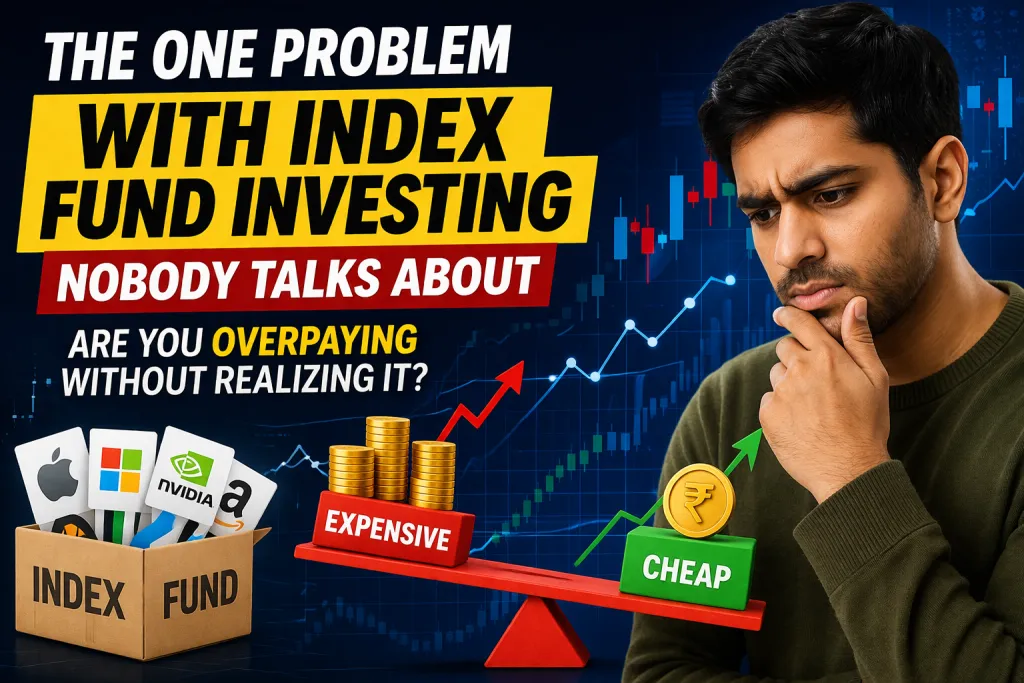
The Big Problem: You're Automatically Buying More of What's Already Expensive
Here's the sneaky thing most people skip over. Index funds are "market-cap weighted." That's a fancy phrase — let's break it down.
Imagine a class where the tallest kids always get the most pizza. The taller they grow, the more pizza they get. The shorter kids? They get almost nothing — even if they're getting taller faster than anyone.
In an index fund, the "tallest kids" are the biggest companies by market value. The bigger the company, the more of your money automatically goes into it.
Let's look at the real numbers. In the S&P 500 index today, just a handful of companies take up a massive chunk of your investment:
Apple (AAPL): ~7%
Microsoft (MSFT): ~6.5%
Nvidia (NVDA): ~6%
Amazon (AMZN): ~3.7%
The other 495 companies: ~76% split between them
So when you put $1,000 into an S&P 500 index fund, about $70 goes to Apple alone. You thought you were getting a balanced variety pack — but really, the biggest candies take up most of the box!
Why Does This Create a Real Problem?
Because this creates a dangerous feedback loop. The bigger a company gets, the more money index funds pour into it, which makes it even bigger, which means funds pour even more in — whether or not the company is actually worth that price. Here are some of the examples, which will discuss below.
The Dot-Com Crash (2000)
In 1999, everyone was excited about internet companies. Stocks like Cisco and Yahoo! grew enormously. Because they were so big, index funds automatically poured more and more money into them. This pushed prices even higher. Then in 2000, the bubble burst, and people who were "safely" in index funds lost 50–80% on those top stocks. The fund had automatically loaded up on the most expensive, most overvalued stocks right before the crash.
Japan's Nikkei (1989–2023)
In 1989, Japan had the biggest stock market in the world. If you had an index fund tracking Japanese stocks, you would have been extremely concentrated in those booming companies. Then Japan's market crashed — and it took until 2023, yes 34 years, to recover to its previous peak. Index fund investors didn't just pick Japan — the weighting system automatically made them bet big on it at the worst possible time.
Right Now: The "Magnificent 7" (2024–2025)
Today, just 7 companies — Apple, Microsoft, Google, Amazon, Meta, Tesla, and Nvidia — make up about 30% of the entire S&P 500. This means if you invest in an S&P 500 index fund, nearly 1 in every 3 dollars goes into just these 7 companies. They're incredible businesses — but if their prices are already very high (and some argue they are), an index fund keeps automatically buying more of them at those high prices.
Here's the core issue in one sentence: Index funds are programmed to buy more of whatever just got expensive, and less of whatever just got cheap. That's the opposite of the "buy low, sell high" rule everyone knows about investing.
The Lemonade Stand Analogy
Let's say your town has 10 lemonade stands. You want to invest in all of them equally — $10 each, $100 total. Simple and balanced.
But an index fund doesn't work that way. It says: the more popular a stand is, the more money you put in. So if one stand is really famous and worth $500, but another smaller stand is worth $10, you'd put $50 in the big stand and only $1 in the small one.
Now here's the twist: what if the $500 stand became that popular because it ran a viral video, not because its lemonade is actually that good? You're now heavily invested in hype, not quality. If people stop watching, the stand crashes — and so does your investment.
Index funds reward size, not value — and the biggest companies aren't always the best investments going forward.
Okay, So What Should You Actually Do?
Here's the good news: index funds are still great. This problem doesn't mean you should avoid them — it just means you should be smart about it.
Option 1: Equal-Weight Index Funds
Instead of giving Apple 7% and a small company 0.01%, an equal-weight fund gives every company in the S&P 500 the same 0.2%. You're truly diversified. Funds like RSP (Invesco S&P 500 Equal Weight ETF) do exactly this.
Option 2: Mix in International Funds
Instead of only buying an S&P 500 fund (U.S. only), also invest in international index funds. This way, if U.S. tech stocks get overpriced, you're also in Europe, Asia, and emerging markets, which might be cheaper and growing faster.
Option 3: Keep Investing Regularly (Dollar-Cost Averaging)
Instead of investing all your money at once (which might be when prices are high), invest a fixed amount every month — say ₹5,000 or $100. When prices are high, you buy fewer shares. When prices drop, you automatically buy more. Over time, this averages out your costs beautifully. This strategy is called dollar-cost averaging.
Option 4: Don't Panic When It Falls
The real danger with any index fund isn't the weighting problem — it's you selling when the market drops. In 2020, the market fell 34% in one month due to COVID. People who panicked and sold locked in real losses. People who stayed put had fully recovered by August 2020 — just 5 months later.
The Takeaway
Index funds are like a brilliant student — almost always near the top of the class, rarely fails. But they have one blind spot: they automatically give the most weight to whatever was popular last year, not what'll be popular next year.
When you buy an index fund, you're not equally buying all 500 companies. You're mostly buying the biggest, most famous, and often most expensive ones — and every month, more of your money piles into whatever's already popular.
That's not a reason to quit index funds. It's a reason to understand them, diversify smartly, keep investing steadily, and never, ever panic-sell.
The real secret of investing isn't the perfect fund. It's staying invested long enough for time to do its work. Even a slightly imperfect strategy, held for 20–30 years, beats a perfect strategy held for 2 years.
This article is for educational purposes only and is not financial advice. Always do your own research before investing.