India VIX Simplified: What It Tells You About the Market
Let us Start With a Simple Question: What is Volatility?
Before understanding India VIX, you need to understand one word: volatility.
Think of it like weather. On most days, the temperature in your city is predictable. You know it will be around 30 degrees, plus or minus a degree or two. That is low volatility. But during monsoon season, the temperature can swing wildly, from hot and humid to cold and rainy within hours, and that is high volatility.
In the stock market, volatility means the same thing: how much and how fast prices are expected to move. When prices are calm and steady, volatility is low. When prices swing sharply up and down, volatility is high.
India VIX is simply a number that measures this. It tells you how much volatility the market is expecting over the next 30 days.
So What Exactly Is India VIX?
India VIX is a real-time volatility index calculated by the NSE that measures the market's expectation of Nifty 50 volatility over the next 30 calendar days. It is derived from Nifty 50 options prices and is widely called India's fear index or fear gauge.
The full form is India Volatility Index. It does not tell you whether the market will go up or down. It only tells you how much movement the market is expecting, in either direction.
India VIX was introduced in 2008 by the National Stock Exchange (NSE), modelled after the Chicago Board Options Exchange (CBOE) Volatility Index (VIX), which was first developed in the United States in 1993.
A simple way to remember it: when India VIX is high, the market is nervous. When India VIX is low, the market is calm.
A Real-Life Analogy
Imagine you are planning a road trip from Bengaluru to Coorg. You check the weather forecast. If the forecast says "clear skies, mild wind," you pack light and drive confidently. If the forecast says "heavy rain, possible landslides," you pack rain gear, drive carefully, and maybe even delay the trip.
India VIX is exactly like that weather forecast, but for the stock market. It tells traders and investors what kind of "weather" to expect in the market over the next month. A high VIX reading means pack your rain gear, while a low VIX reading means the road is clear.
How Is India VIX Calculated?
You do not need to be a mathematician to understand this. Here is the idea in plain language:
India VIX is calculated by the NSE using the order book of Nifty options. The best bid-ask quotes of near and next-month Nifty options contracts traded on the NSE's F&O segment are used for this.
Think of it this way. Every day, traders buy and sell options contracts on the Nifty 50. The prices at which they are willing to buy and sell these options carry hidden information: how much movement do they expect in the market? If traders are paying very high prices for options, it means they are expecting big moves. If they are paying low prices, they expect calm markets.
India VIX is updated in real time during market hours, reflecting minute-by-minute changes in Nifty Index option prices. It is calculated by NSE using near and next-month Nifty option data to capture prevailing market volatility expectations.
The result is expressed as an annualised percentage. For instance, a VIX of 15 indicates the market expects 15% annualised volatility, or roughly a movement of plus or minus 0.95% per day on average.
An India VIX reading of 15 means the market expects approximately plus or minus 4.33% Nifty 50 movement over the next 30 days. It does not predict the direction, only the magnitude of expected movement.
Reading the Numbers: What Does Each Level Mean?
Here is a beginner-friendly guide to interpreting India VIX levels:
Below 15: Calm Market, The market is stable, investors are confident, and there is low fear. This is when markets often trend steadily upward. Good time for long-term investors to stay invested.
15 to 20: Normal to Mildly Uncertain. The VIX index normally hovers between 15 and 24, which is considered a normal market condition. Some caution is warranted, but no major panic.
20 to 30: Elevated Fear. The market is getting nervous. Could be ahead of an election, a big policy announcement, or global news. Option premiums become expensive, so traders get more careful.
Above 30: High Fear Zone. When fear is infused, the VIX can rally to 30 levels or more, and investors get nervous. Markets can see sharp swings. Not the time to make impulsive decisions.
Above 50 to 80: Extreme Panic Rare, but it happens. The market is in crisis mode. In the 2008 global financial crash, the VIX reached a level of 92, whereas during the 2020 Covid crash, it went up to 86.63.
The Golden Rule: India VIX and Nifty Move in Opposite Directions
This is the most important thing for a beginner to understand.
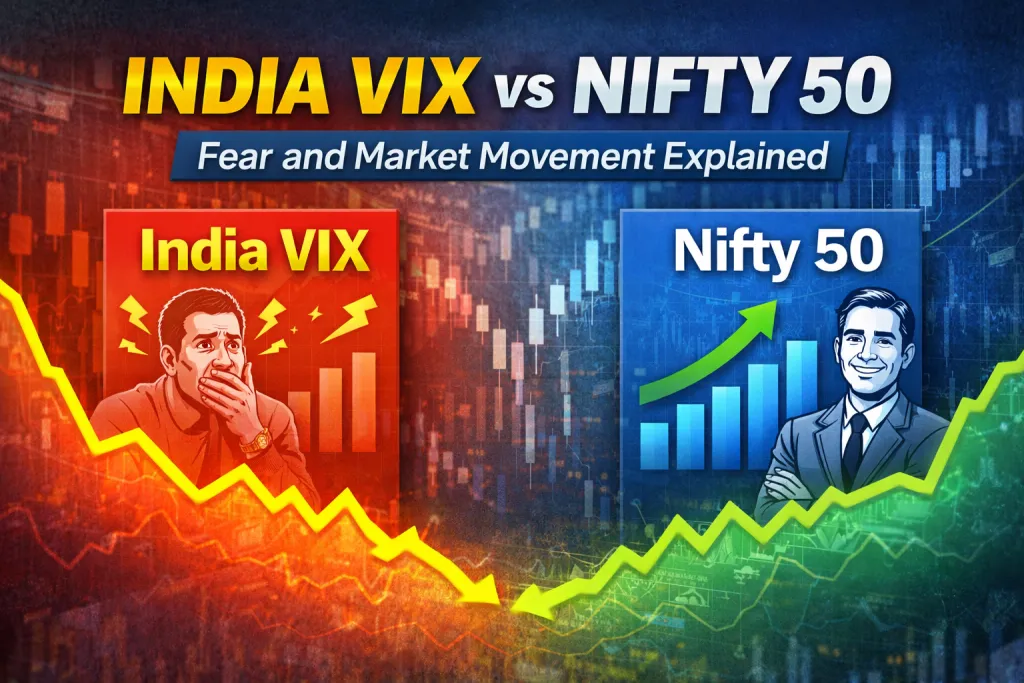
India VIX and Nifty 50 have often been observed to move inversely. When Nifty rises, India VIX usually declines, indicating reduced fear. On the other hand, when Nifty falls, India VIX tends to rise, signalling increased uncertainty.
Here is a real-life example of this in action:
On January 20, 2020, India VIX was at its lowest point of 10.165, and on that same day, the market topped. On March 24, 2020, India VIX hit its highest point of 86.635, and on that same day, the market bottomed.
What this tells you: extreme VIX levels can sometimes be a signal of a turning point. When everyone is panicking, and VIX is sky high, markets are often near a bottom. When everyone is complacent, and VIX is very low, markets may be near a top. This is why experienced investors sometimes use VIX as a contrarian indicator.
Real Historical Events Where India VIX Spiked
Here are some moments in history where India VIX shot up dramatically, and what caused them:
1. COVID-19 Crash (March 2020) The onset of the COVID-19 pandemic in March 2020 resulted in an unprecedented spike in India's VIX. As the virus spread rapidly and markets crashed, the VIX soared, highlighting the heightened fear and uncertainty among investors. VIX touched 86.63, its all-time high.
2. Lok Sabha Elections 2024 The fear index soared by nearly 44%, marking its highest single-day gain in nine years, amidst strong election count trends. In May 2024, India VIX reached 52-week high levels during the general elections. In contrast, periods of economic stability or post-event clarity usually saw the index return to sub-15 levels, reflecting calmer investor sentiment.
3. Global Market Crash, August 2024 The perfect storm of global factors, including the unwinding of yen carry trades, escalating geopolitical tensions between Israel and Iran, political turmoil in Bangladesh, and weak US economic data, culminated in a sharp rise in VIX of nearly 60% in a single session.
4. 2014 Lok Sabha Elections India VIX touched a high of 39.30 during the 2014 Lok Sabha Elections. Even a widely anticipated election result created significant uncertainty before the outcome was known.
Notice the pattern: every time there is uncertainty, VIX goes up. Elections, pandemics, wars, policy changes — any event where the future feels unclear causes VIX to rise.
Why Should a Beginner Care About India VIX?
Even if you are not trading options or futures, India VIX is useful to you. Here is how:
For long-term investors (SIP, mutual funds): A high VIX during a market crash can be a signal not to panic and exit. Long-term investors can use VIX spikes as an indicator to avoid panic selling and look for entry points when the stock is undervalued. Think of it as a sale on stocks, not a reason to run away.
For short-term traders: When India VIX is below 15, markets are quiet and stable, suitable for directional trades. When India VIX is above 20, option premiums rise, and the environment becomes more expensive to trade in.
For options buyers and sellers: High VIX leads to expensive option premiums. Traders can sell options when VIX is high and buy them when VIX is low, using it as a pricing signal.
Where Can You Check India VIX?
India VIX is calculated only during NSE trading hours from 9:15 AM to 3:30 PM IST. Historical VIX data is available on the NSE website for backtesting and comparative analysis. You can also find it on financial platforms like Zerodha, Groww, Moneycontrol, and NSE's own website at nseindia.com. It is listed as "INDIA VIX" and is updated every few seconds during market hours.
Common Myths About India VIX
Myth 1: "High VIX means the market will definitely crash." Not true. India VIX does not predict market crashes. It indicates the level of expected volatility, not the direction of market movement. A sharp rise in VIX often signals heightened uncertainty, but it only reflects traders' expectations of potential fluctuations, not a guaranteed fall or rise in equity markets.
Myth 2: "VIX measures actual past price movement." Not true. VIX measures expected future volatility, not what has already happened. It is forward-looking, not backwards-looking.
Myth 3: "VIX going to zero means the market is perfectly safe." India VIX cannot go to zero and does not reflect market direction. It simply shows how much volatility investors anticipate in the near future.
The Bottom Line
India VIX is one of the most powerful yet underused tools available to everyday investors and traders in India. It is essentially the market's mood ring. When it is calm and low, confidence is high. When it is flashing red and high, fear has taken over.
You do not need to understand the complex mathematical formula behind it. What matters is the simple principle: watch VIX like you watch the weather before stepping out. An understanding of India VIX's meaning and how this index behaves in relation to the Nifty 50 allows you to progress past only looking at price charts and consider the psychology behind the market when making trading decisions.
Markets are driven by two emotions: greed and fear. India VIX measures the fear part. And knowing when the market is afraid, and when it is not, is one of the most valuable edges any investor can have.